How to Sync Conference Room Calendars Between Organizations
Table of Contents
Sync Your Conference Rooms in Minutes
Use the modular Calendar Sync offered by OneCal to automatically sync multiple conference room calendars between organizations.
Sharing conference room calendars between organizations is challenging. This becomes even more challenging when organizations use different calendar providers, i.e., one organization uses Google Calendar and the other uses Outlook.
In this article, we’ll explain in detail how to sync conference room calendars between organizations, making it easy for employees from multiple organizations to stay updated with the availability of all conference rooms, avoiding scheduling conflicts and confusion.
Quick answer: Google Workspace and Microsoft 365 have admin features that show free and busy time across organizations, but they don't add another company's room to your room list, and they don't copy bookings between rooms. The most reliable way to share a room is to give it a room calendar in each organization and keep those calendars in real-time sync with a calendar sync tool like OneCal. Using OneCal, a booking made in one organization blocks the room in the other organization.
Can you natively share conference and meeting rooms between organizations using Outlook and Google Calendar?
There is no native feature that makes a conference room from another organization bookable in your own calendar system, although admin features can share availability, each with its own limits.
Option | Works between | What it gives you | What it does not do | Who sets it up |
|---|---|---|---|---|
Export or publish the room calendar (ICS) | Any two providers | A view-only copy of the room calendar | It is slow, and booking tools ignore it | A user with access to the room calendar |
Organization relationship | Two Microsoft 365 organizations | Free and busy lookups when you type the address of the other side | The room is not listed in your room finder, and no events are copied | Exchange admins of both organizations |
Google Calendar Interop | Google Workspace and Exchange | Availability lookups between the two systems, and an option that lets Google Calendar users book Exchange rooms | No events are copied, and the setup is technical | A Google Workspace admin and an Exchange admin |
Calendar sync with OneCal | Google, Microsoft 365, or both | Bookings are copied between the room calendars in real time | It does not block two people from booking at the same minute | An admin or user with access to the room calendars |
Organization relationships. Two Microsoft 365 organizations can set up an organization relationship in Exchange Online, which Microsoft describes as a one-to-one relationship that lets users in each organization view calendar availability. The relationship must be set up at both ends, and each admin chooses whether to share free/busy time only or also the subject and location. For conference rooms or meeting rooms, this has two major gaps.
- First, the other organization's room does not appear in your address list or room finder, so people have to type the room's email address to see when it is free.
- Second, the relationship only shares availability, so whether an outside user can book the room depends on how the other organization has configured the room mailbox.
Google Calendar Interop. Google Workspace has an admin feature called Google Calendar Interop that connects Google Calendar with Exchange so users can see availability across the two systems. A Google Workspace admin sets it up in the Admin console, and an Exchange admin has to create role accounts and register an app on the Microsoft side. An optional step lets Google Calendar users book Exchange rooms once the Exchange admin adds those rooms to a special room list and allows them to accept requests from outside. Google describes this for one organization that runs both systems, and it only works in that direction. It also doesn't copy events, and because IT builds and maintains it, it is a large project for two separate companies that only want to share a few rooms.
Exporting or publishing the room calendar. You can publish a room calendar and add it to the other calendar system as an ICS link, but that doesn’t mean you can see the meeting room's availability when trying to book it.
Example:
Acme Inc. is a corporation that uses Outlook to manage its conference rooms. These conference rooms are also used by Wayne Enterprises, which uses Google Calendar. Acme Inc. can export the meeting room calendars one by one and import them into Google Calendar.
Still, when a Wayne Enterprises employee tries to use the ‘Find a Time’ feature on Google Calendar to book a room, they won’t be able to see when the conference room is free. The room is not a bookable resource in the Wayne Enterprises directory, and the imported copy is only a read-only overlay calendar, so booking tools like ‘Find a Time’ and the Outlook Scheduling Assistant ignore it.
If you still want to try out manually exporting these conference rooms, please follow our previous articles on:
- How to sync Outlook Calendar with Google Calendar
- How to sync multiple Google Calendars
- How to Sync multiple Outlook Calendars
Generally, aside from the main problem that you can’t view the availability when exporting calendars, this solution has multiple issues:
- The sync is not real-time. If Acme Inc. creates a meeting in a conference room on Outlook, it might take up to 24 hours for that meeting to reflect in Wayne Enterprises’ Google Calendar.
- Limited Privacy Options: Even when the meeting room booking is reflected, you have little control over what event properties you want to sync from one calendar to another. Since you’re sharing the calendars from one organization to another, you might want more control over what’s shared.
How to automatically sync meeting/conference rooms between organizations in real time?
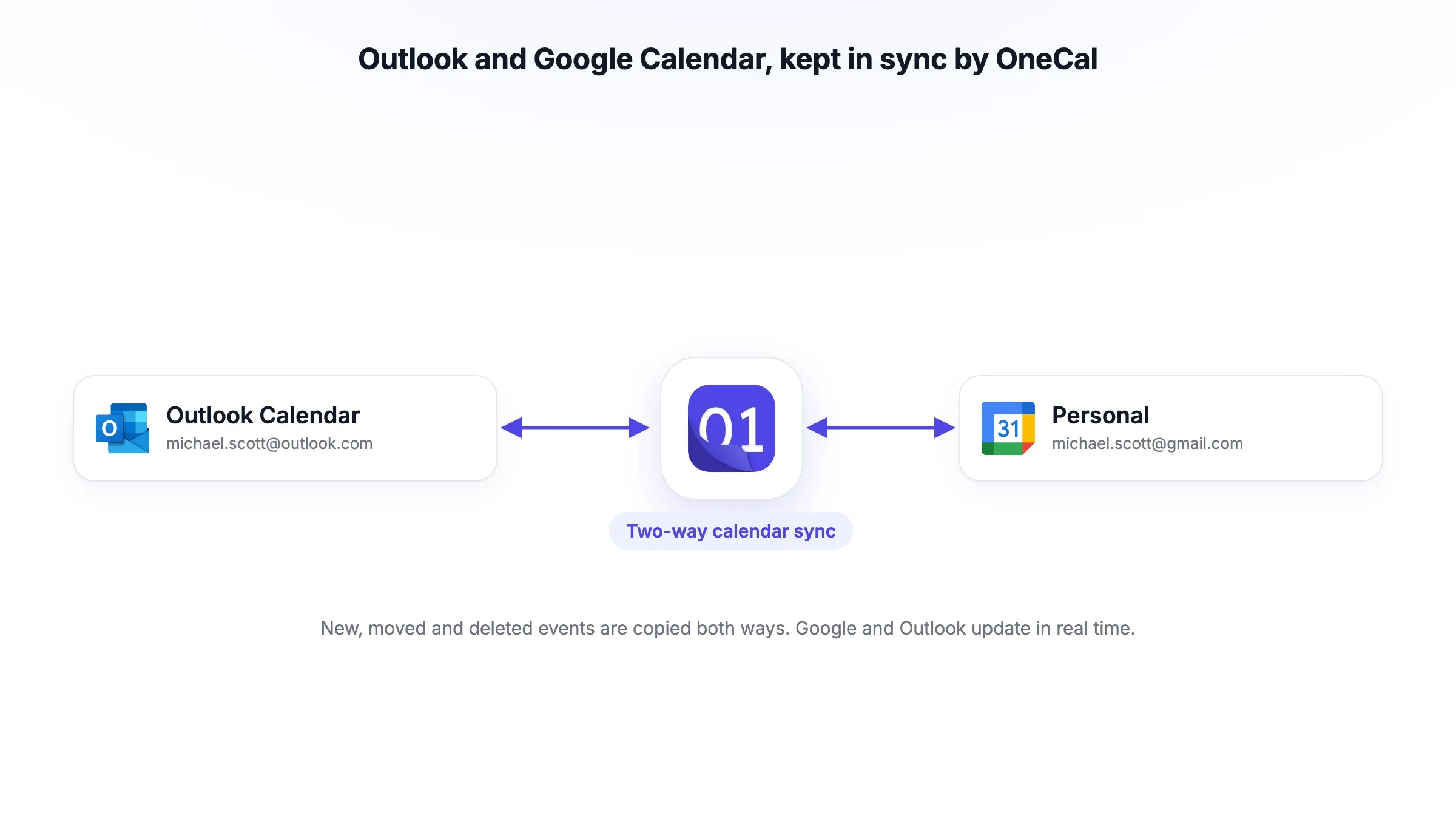
To automatically sync your conference rooms between organizations in real-time, you must use a Calendar Sync Tool like OneCal.
With OneCal, you can connect and sync multiple Outlook and Google Calendars in real-time.
This method bypasses the issues explained above because OneCal uses the official Outlook and Google Calendar APIs to directly clone the conference room meetings from one calendar to another.
If you then use the ‘Find a Time’ feature on Google Calendar or the Scheduling Assistant in Outlook, you can see the full availability of your conference rooms, as the meetings are synced into the room calendars of each organization.
How it works: one room calendar in each organization
The shared room gets a room calendar in each organization: Acme Inc. keeps its room mailbox in Microsoft 365, and Wayne Enterprises creates a resource calendar with the same room name in Google Workspace. OneCal keeps the two calendars in sync, so employees of each company book the room as they always do from their own room list, and the booking shows in the other company’s room calendar right away.
It helps to turn on automatic acceptance for each room calendar, so a booking is confirmed as soon as it is made.
How to connect meeting room calendars to OneCal
Room calendars are resource calendars, so the way you connect them depends on the provider:
- Google Workspace: You can't sign in as a Google resource calendar, so a Workspace admin shares each room’s resource calendar with one user account and gives it permission to make changes to events. The room calendars then show in that user’s calendar list, and you connect that user account to OneCal.
- Microsoft 365: Connect the room mailbox itself. A room mailbox has a sign-in account that is turned off by default, but an Exchange admin can turn it on and set a password; you can then connect the room to OneCal like any other Microsoft account. A room calendar shared only with a user account does not work for this setup because OneCal treats a calendar shared from another mailbox as a shared calendar. Because of Microsoft API limits, a shared calendar can only be the source of a one-way calendar sync, and it cannot be a target or part of a multi-way calendar sync.
We recommend a dedicated account for the Google side, for example, an office manager or IT account, and not the account of a person who may leave the company.
Automatically sync meeting rooms using these steps:
- Start a 14-day free trial of OneCal (no credit card is needed): You can try out the platform for 2 weeks at no charge.
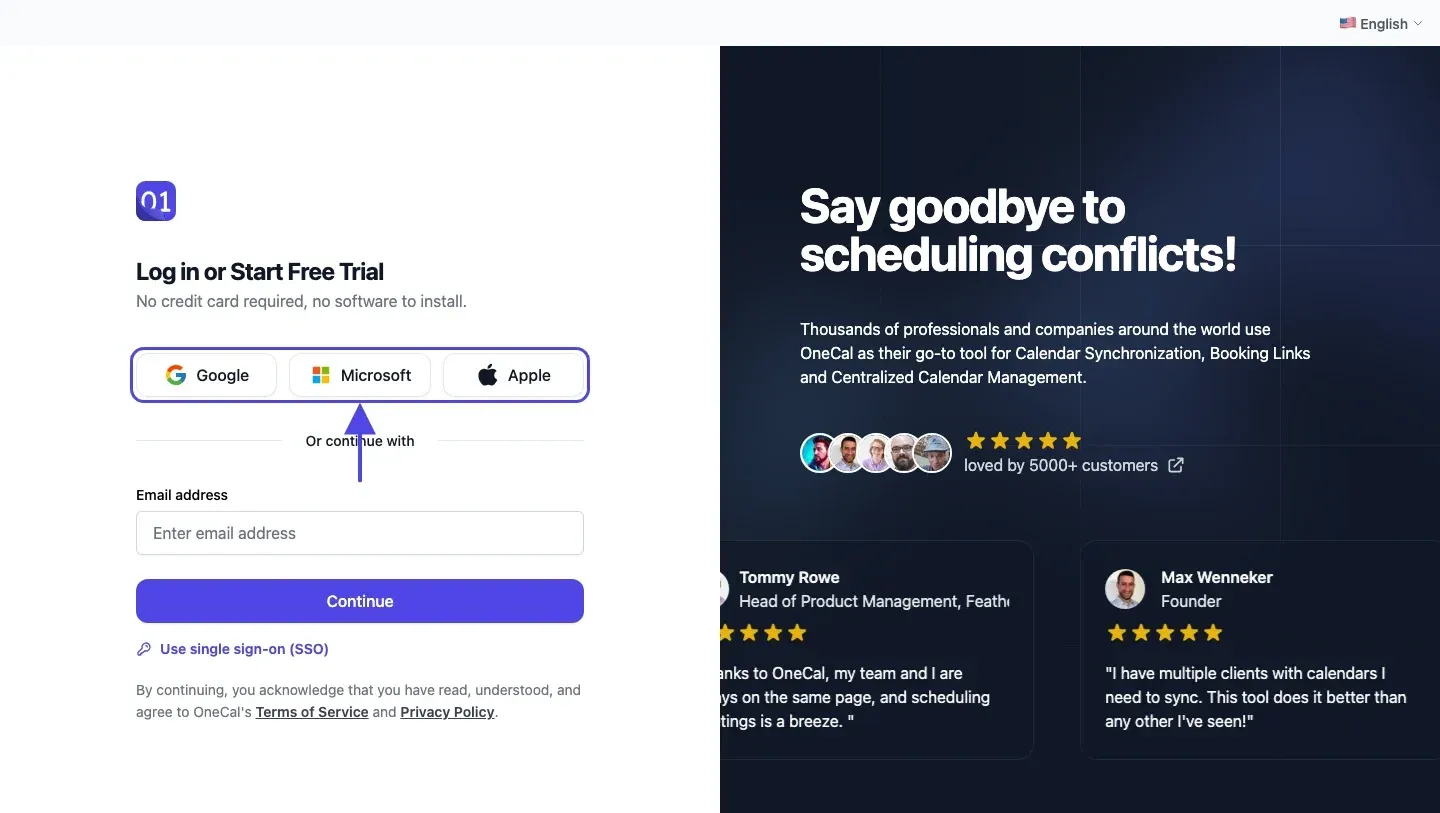
- Connect all your conference room calendars and the calendars you want to share these conference rooms to: OneCal offers a modular calendar sync software, allowing you to sync from one conference room to another or sync multiple conference rooms simultaneously. Use the ‘Connect Calendar’ button on the Calendar Sync page to connect the room mailboxes and the Google accounts that have access to the room calendars, as explained above.
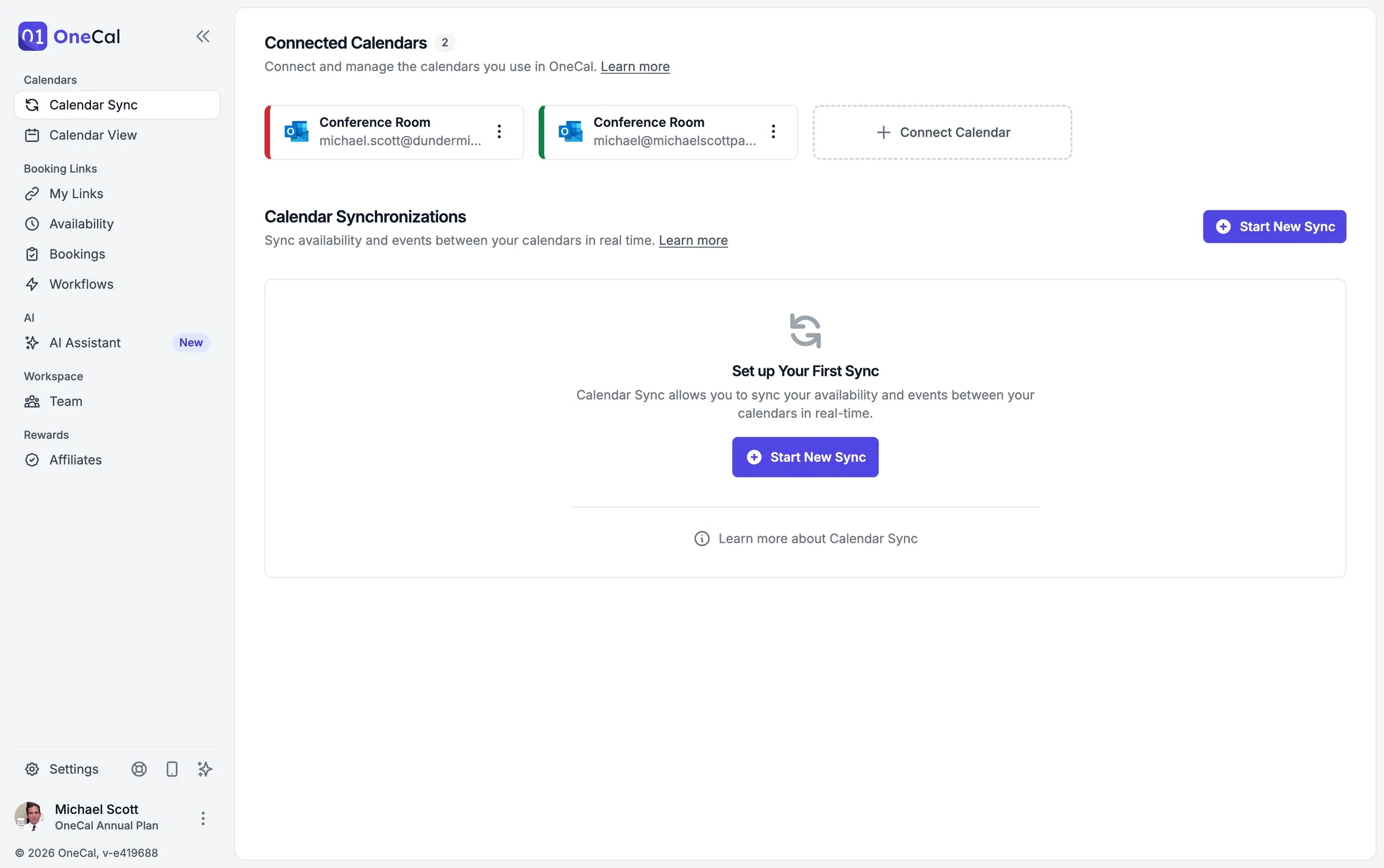
- Click ‘Start New Sync’: After connecting all your calendars, the next step is to start syncing each conference room between different organizations. For this example, we’ve chosen two companies, Acme Inc. and Wayne Enterprises, where we’ll sync each conference room between both organizations.
- Give the sync a name and a direction: The name is just an identifier to help you distinguish the syncs from one another. The sync direction dictates where the events are copied from and where to. One-way means events go from one calendar to one or more other calendars. Multi-way means events go both ways, so all the calendars you select always stay in sync. For this example, we’ll select multi-way, as we want to keep conference rooms in sync between Acme Inc. and Wayne Enterprises.
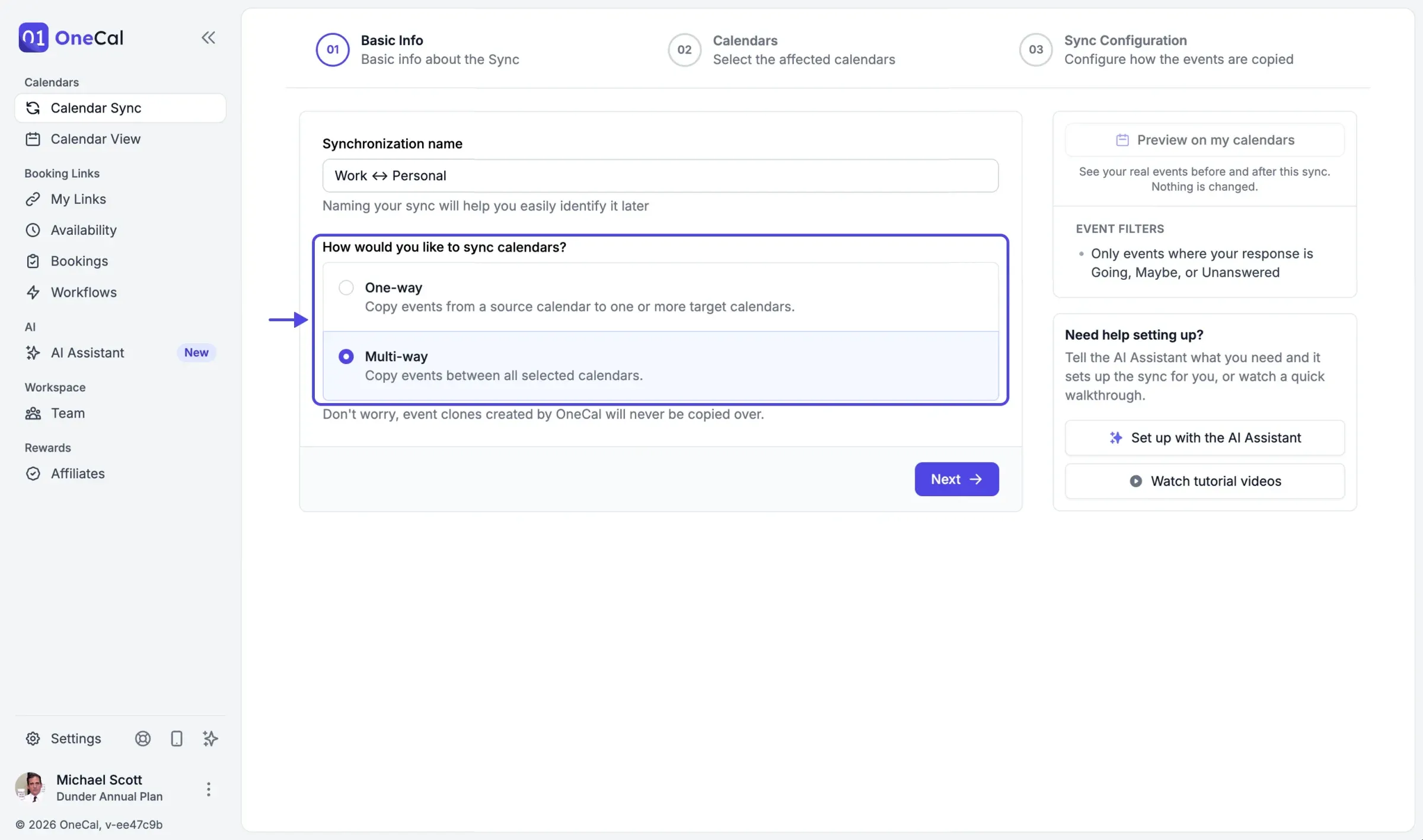
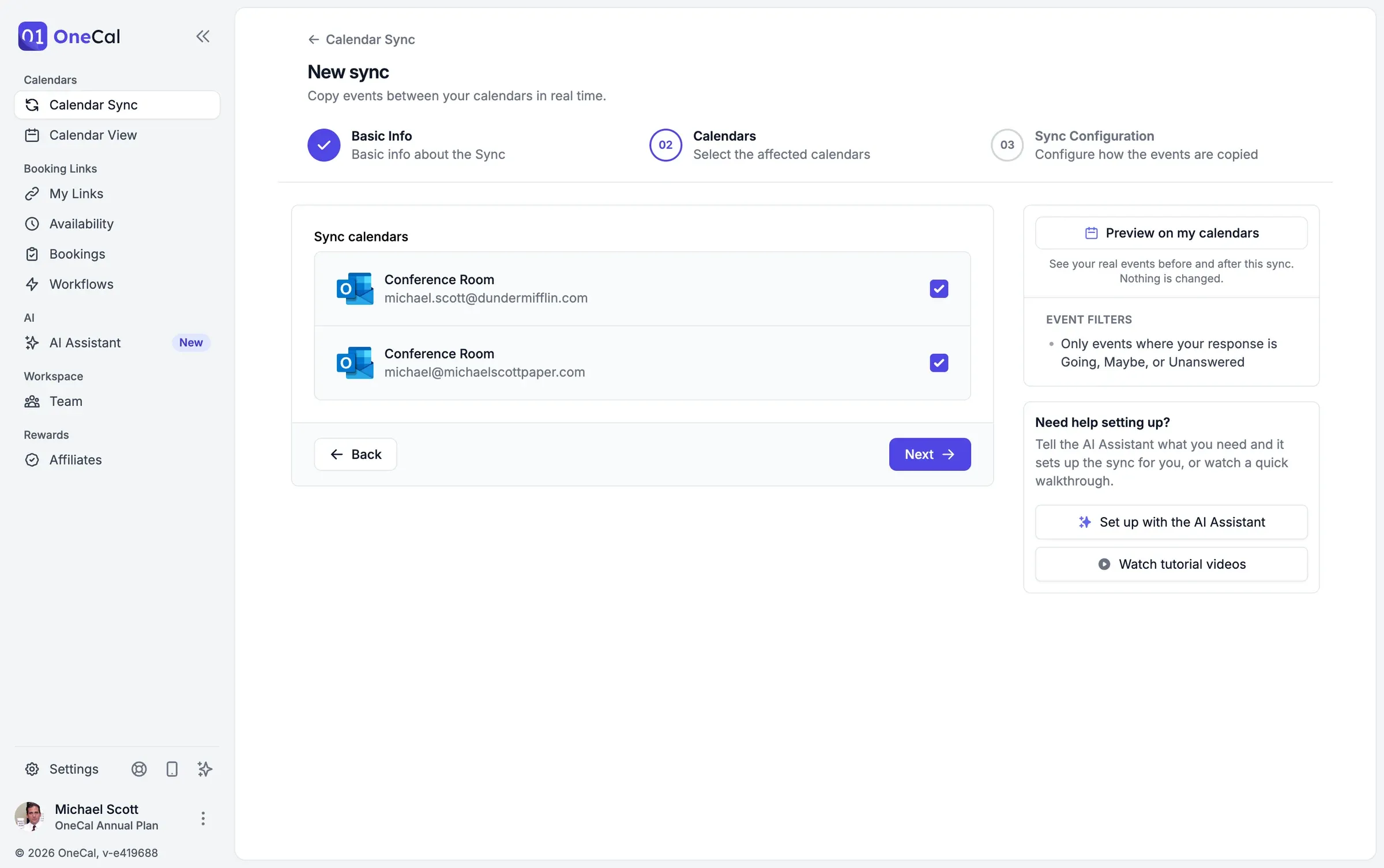
- Select the conference rooms to keep in sync: Select the room calendar of the same room in each organization, and after selecting the calendars, click ‘Next’.
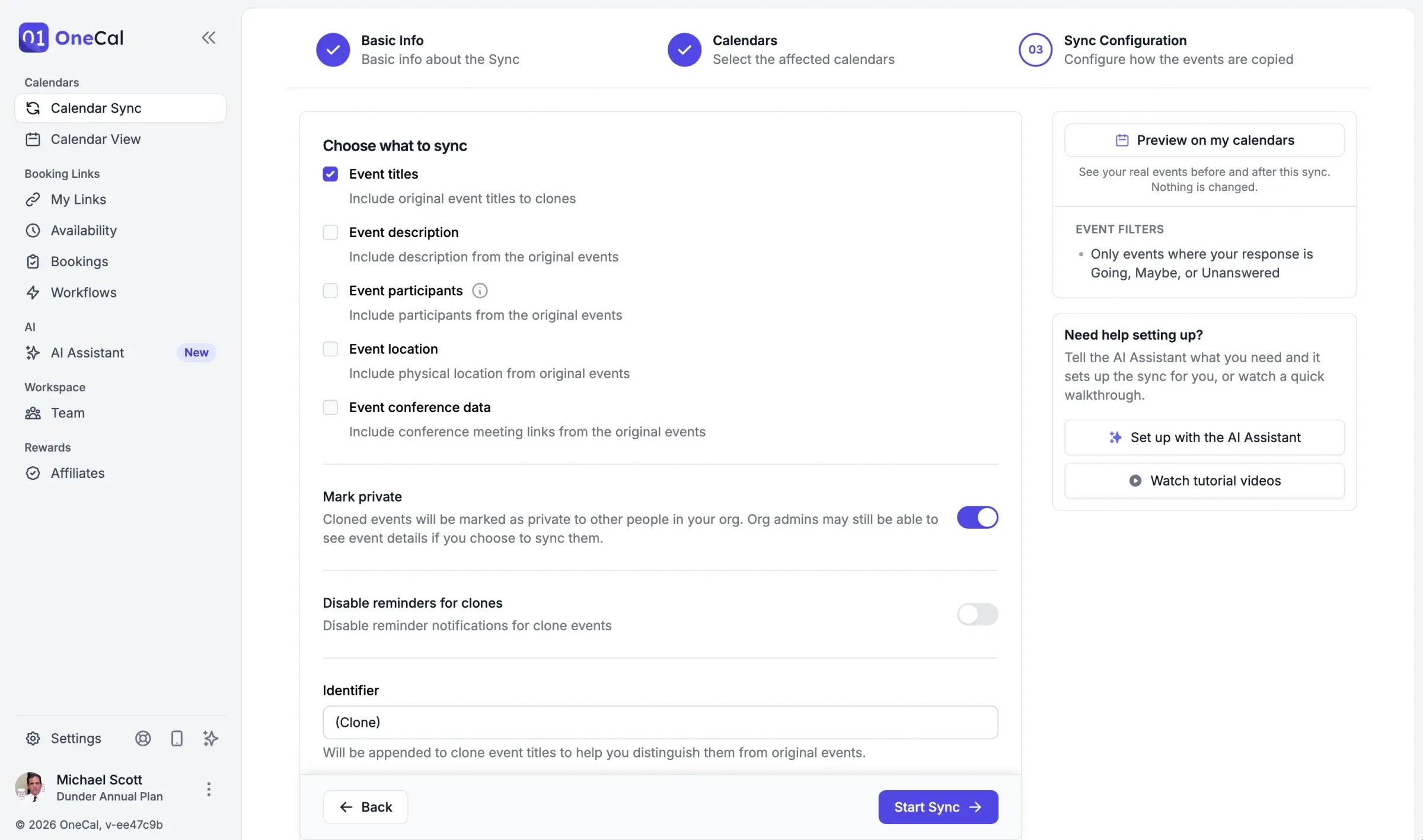
- Select what to sync between conference rooms: In the Sync Configuration step, OneCal offers a customizable calendar sync, allowing you to choose which event properties are synced from one conference room to another. You can sync event names, descriptions, meeting links, assign them colors, and much more. For the sake of keeping the example simple, we’ll only sync the event titles, and assign the synced events a color. Read the section on which details to share below before you decide.
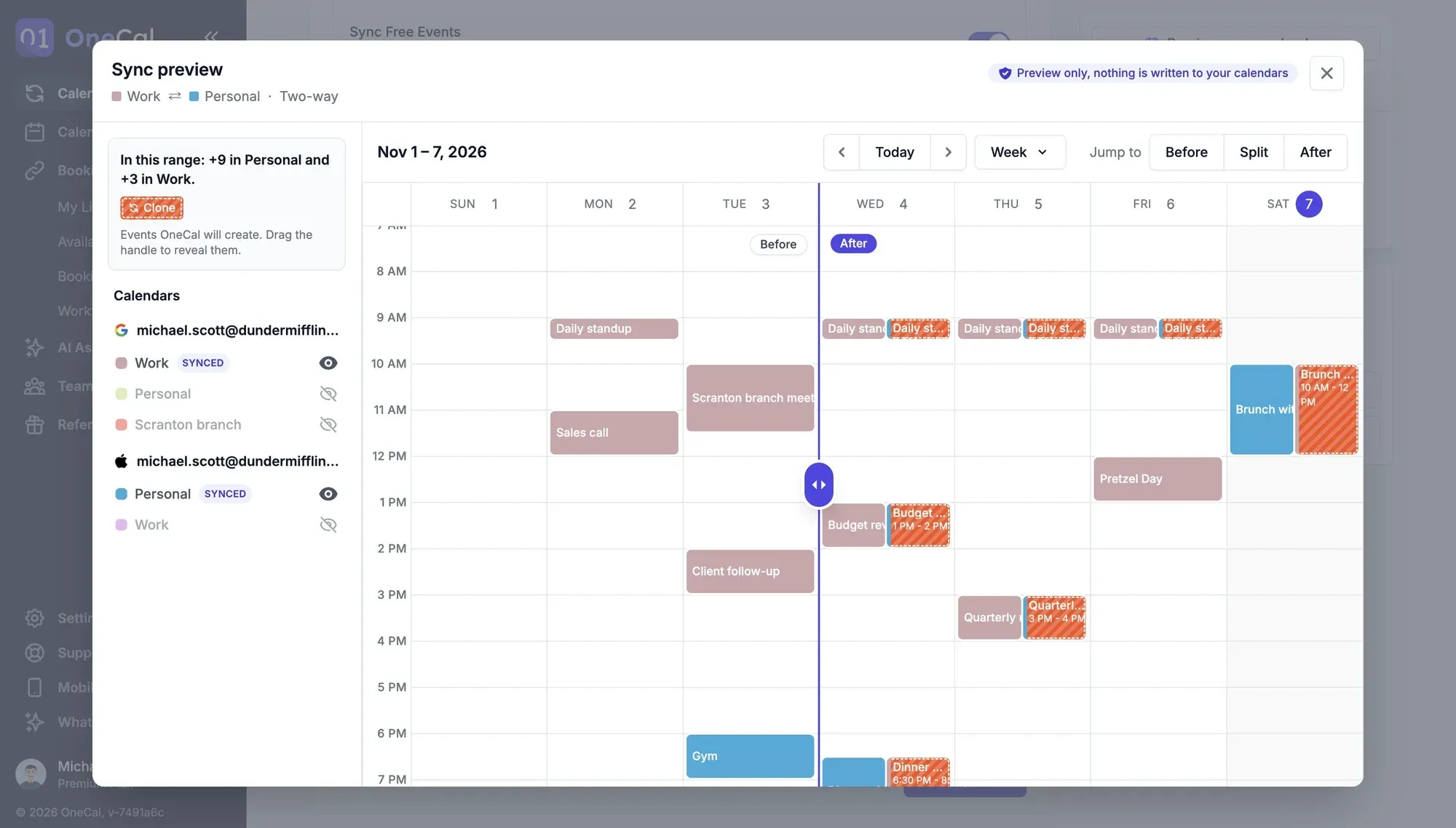
- Preview the result: Click ‘Preview on my calendars’ to see the real bookings of the room calendars before and after the calendar sync. The preview does not change anything in your calendars.
- Click ‘Start Sync’: To complete the setup of syncing multiple conference rooms between organizations, click ‘Start Sync’.
Your Conference Rooms are now synced between two organizations!
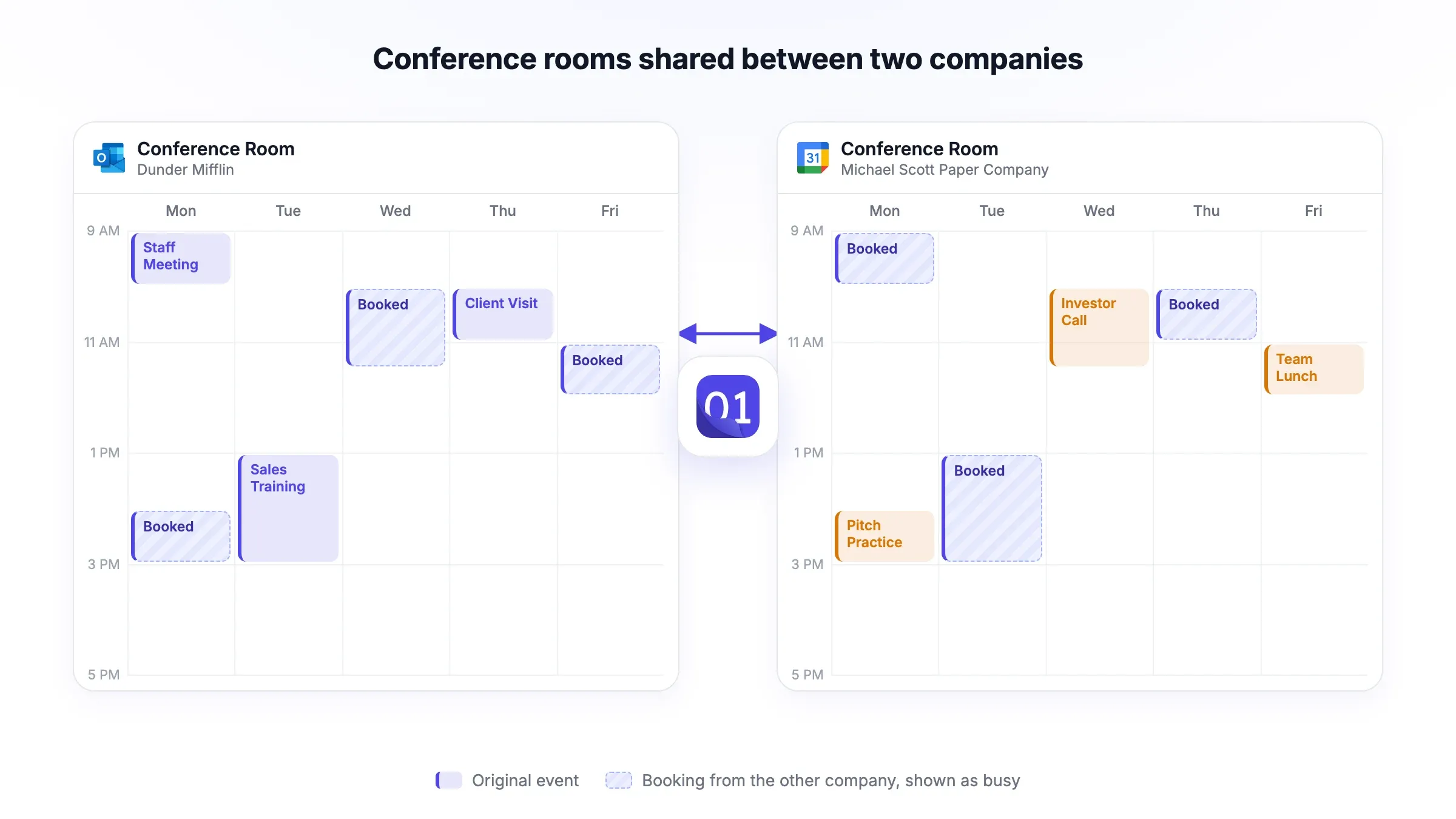
You can follow the steps showcased above to sync more conference rooms. Depending on your needs, you can choose to mark all conference events private or configure the sync differently than we did. What’s important is that the conference rooms will stay in sync automatically, in real-time.
Here is how a setup syncing multiple meeting rooms between two organizations would look like:
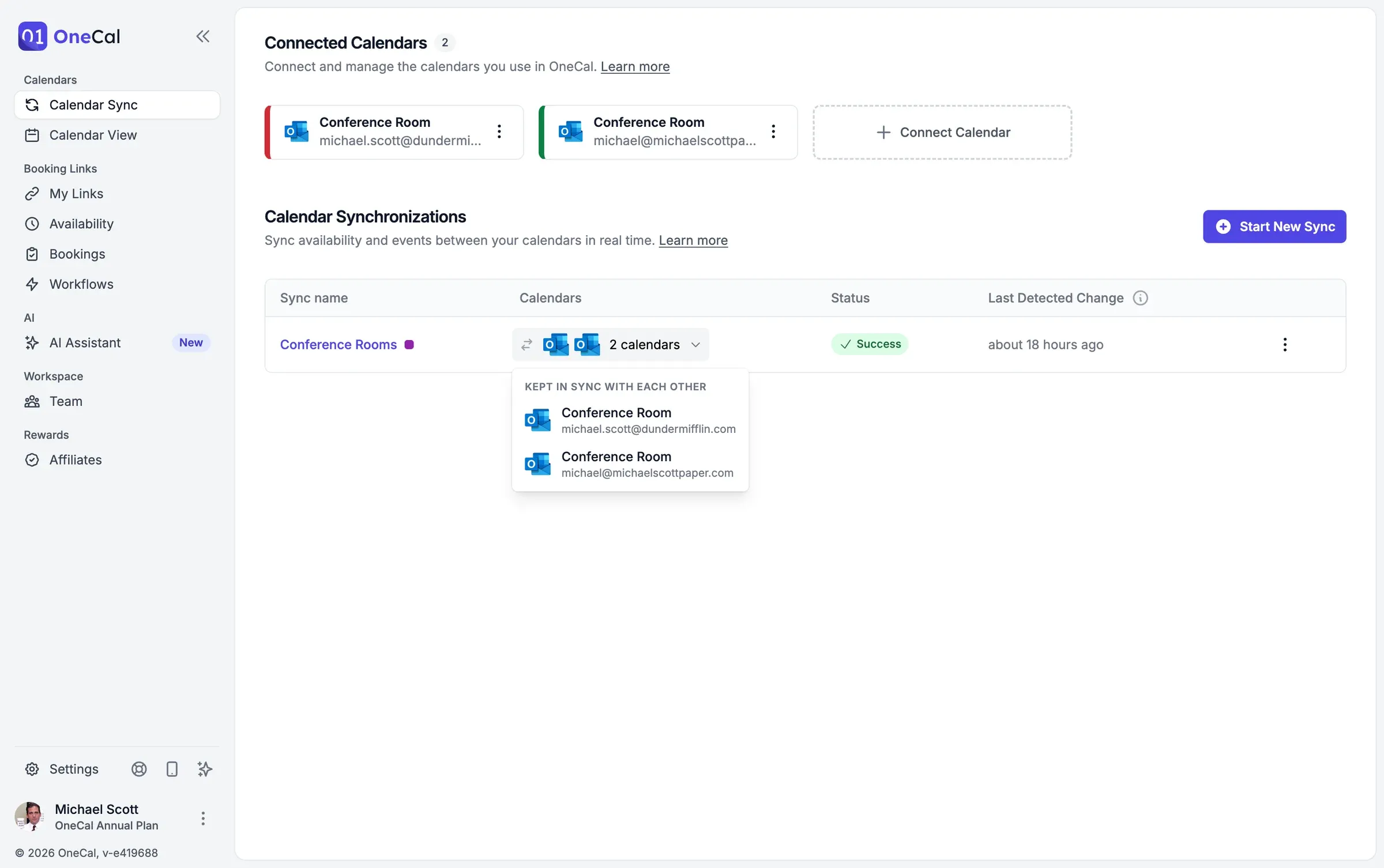
You can pause a calendar sync at any time and unpause it later, for example, while a room is being renovated. If a calendar sync is paused because of an error, such as a removed permission, OneCal shows the reason and sends you an email, so a shared room does not go out of sync without anyone noticing.
For any further questions about setting up your conference room calendar sync, you can reach out to contact@onecal.io directly; we’ll do our best to help you out. If you plan to sync a large number of rooms, mention it in your message so we can advise you on the Premium and Enterprise plans.
Which meeting room details should you share with the other organization?
When you sync a room between two companies, the employees of the other company can see whatever you copy. A title like “Salary review” or “Acquisition talks” should not appear on another company’s calendar. We recommend these settings for shared rooms:
- Turn off Event titles and type a custom title, such as the room name plus “Booked”, in the Event titles text field further down the form. OneCal uses it as the title of every synced booking.
- Leave Event description and Event participants turned off.
- Turn on Mark private.
The room is still blocked for the right time, which is all the other organization needs to know.
Meeting room sync between two Microsoft 365 tenants or two Google Workspace domains
The example above uses one organization on Outlook and one on Google Calendar. The same steps work when both organizations use the same provider:
- Two Microsoft 365 tenants: Connect the room mailbox of the room in each tenant, as described above, then create the multi-way calendar sync between the two room calendars. This is a common setup for cross-tenant room booking, because an organization relationship does not add the other tenant’s rooms to your room finder.
- Two Google Workspace domains: Connect one account from each domain that has access to the resource calendars, then create the multi-way calendar sync.
One multi-way calendar sync can hold up to 8 calendars, so the same room can be kept in sync across more than two organizations. You can reach out to contact@onecal.io to request an increase of the calendar limit on a multi-way calendar sync setup.
Shared offices and coworking spaces
In a shared office, several companies use the same meeting rooms, and each company has its own calendar system. Give each shared room a room calendar in every company, and connect them in one multi-way calendar sync. Every tenant then sees the real availability of the shared office room calendar in their own Google Calendar or Outlook, and they see only “Booked” and not the meeting details of their neighbors.
Mergers and acquisitions
After a merger, the two companies often share offices long before their Microsoft 365 or Google Workspace accounts are merged. A calendar sync between the room calendars lets both sides book the same rooms from day one, without waiting for the migration. Once the migration is done, you can delete the calendar sync. Our guides on migrating from Google Workspace to Microsoft 365 and migrating from Microsoft 365 to Google Workspace cover the rest of the move.
For the IT admins of both organizations
A room calendar sync connects two companies, so IT on both sides will have questions. These are the facts that usually matter:
- Access control: With Allowed Calendars, a OneCal admin restricts which accounts and domains can be connected, for example, only the two company domains.
- Ownership: With Admin Managed Accounts, one admin can manage the accounts that hold the room calendar syncs, so the setup does not depend on one employee.
- Sign-in: OneCal supports SSO with SAML and OIDC, and SCIM directory sync, available on all plans, no need pay extra.
- Audit logs: Admins can review activity and export it as a CSV file.
- Security: OneCal is SOC 2 Type II compliant and GDPR compliant, and offers a DPA. It does not store calendar event data, and data is encrypted in transit and at rest. Reports and policies are in the OneCal Trust Center.
You can read more on the admin management page. If a Microsoft 365 tenant shows a ‘Need admin approval’ screen when you connect an account, follow our guide on how to request admin approval.
When a calendar sync is not enough
A calendar sync keeps room calendars in step, but it is not a room booking system. If you need booking rules, check-in at the door, room display panels, or a hard block on double bookings, look at dedicated room booking software. If you only need each organization to see and respect the other's bookings, a calendar sync is the simpler choice.
Use OneCal to sync conference and meeting rooms in real-time
OneCal is a reliable calendar sync platform for syncing conference rooms. Our customers use our system to sync hundreds of conference rooms across different locations, saving time and improving communication between multiple organizations.
Calendar syncs are unlimited on every plan, and one multi-way calendar sync holds up to 8 calendars. The number of calendars you can connect depends on the plan: 2 on Starter, 5 on Essential, and 50 on Premium, per user. Setups with many rooms usually need the Premium plan or an Enterprise plan. You can compare them on the pricing page.
Start a 14-day free trial of OneCal. You don't need a credit card or further commitment to start syncing your meeting rooms.
FAQ
Can you natively sync conference room calendars between Outlook and Google Calendar?
Not fully. Admins can share free/busy time through Google Calendar Interop or a Microsoft 365 organization relationship, and you can add a room as an ICS calendar. None of these makes the other organization’s room bookable in your room list, and none copies the bookings.
Why can’t Google’s “Find a Time” or Outlook’s scheduling tools see an imported room’s availability?
A room from another organization is not a bookable resource in your directory, and an imported ICS copy of its calendar is only a read-only overlay that those booking tools ignore.
What problems arise when you export and import room calendars manually?
Aside from not syncing calendars and not blocking availability (the calendar import creates a separate, read-only calendar), updates aren't real-time (24-hour delays), and you have little control over which event details are exposed.
Is cross-tenant room booking possible in Microsoft 365?
Only in part. An organization relationship lets users see a room's free/busy time in another tenant when they type its email address, but the room does not appear in their room finder. To give both tenants a room they can book normally, create a room calendar in each tenant and sync the two.
How can you sync room calendars between organizations in real-time?
Use a calendar sync service like OneCal, which directly syncs meetings between Outlook and Google calendars.
Can you choose which event details are copied during the sync?
Yes. OneCal is fully configurable; you can choose to sync each field individually or exclude events by color.
Does OneCal support syncing rooms for more than two organizations?
Yes. You can add multiple Google and Outlook tenants and set up multi-way calendar syncs among any combination of room calendars; one multi-way calendar sync supports up to 8 calendars.
How fast are changes reflected across synced conference rooms?
Typically, within seconds. Once a meeting is created, updated, or deleted, OneCal reflects the change to all linked calendars right away.
What happens if two organizations book the same room at the same time?
Both bookings are copied to the other side, and both room calendars show the overlap. A calendar sync shows the conflict but does not prevent it, so one of the meetings has to be moved. Because changes are copied within seconds, this only happens when two people book at the same time.
Can we color-code events from different organizations for clarity?
Yes. During setup, you can assign a specific color to all events copied from each source calendar.
Is the data secure when our organizations connect calendars to OneCal?
Yes. OneCal is SOC 2 Type II compliant and GDPR compliant, offers a DPA, and uses the official Google and Microsoft APIs. OneCal does not store calendar event data, data is encrypted in transit and at rest, and you can revoke access at any time. You can find more on the OneCal Data Security page and in the OneCal Trust Center.