How to Merge Outlook Calendars: 3 Ways That Work (2027)
Table of Contents
Ready to merge your Outlook Calendars?
Start a 14-day free trial of OneCal to automatically merge all your Outlook Calendars in minutes.
Microsoft Outlook is one of the biggest calendar providers, used by individuals, companies, and large enterprises. While managing a single Outlook Calendar is easy, things get complicated when juggling two or more Outlook calendars. The question that comes to mind in this situation is, how to merge multiple Outlook calendars?
Outlook has no "merge" button that merges Outlook calendars, and people mean three different things when they ask for one. In this article, we explain all three, with steps for new Outlook, classic Outlook, and Outlook on the web.
Quick answer
- If you want to see several calendars as one, use overlay view, which takes a few clicks and changes nothing in your calendars.
- If you want to move all events into one calendar for good, export one calendar and import it into the other for a one-time copy.
- If you want two calendars to keep mirroring each other, so coworkers always see your real availability, use a calendar sync tool like OneCal.
Way to merge | What it does | Stays up to date | Coworkers see your busy time | Where it works |
|---|---|---|---|---|
1. Overlay view | Shows several calendars in one view | Yes, it is only a view | No | Classic Outlook, new Outlook, Outlook on the web |
2. Export and import | Copies all events into one calendar | No, it is a one-time copy | Yes, for the copied events | Full export and import in classic Outlook, while new Outlook and the web can only import an .ics file |
3. Calendar sync | Mirrors events between multiple calendars | Yes, in real time | Yes | Any Outlook account, also across organizations |
Prefer video? Here is our step-by-step tutorial on keeping multiple Outlook Calendars merged automatically.
Merging Outlook Calendars differs between the Outlook apps
The steps that we'll follow to merge Outlook calendars together differ between the Outlook apps, so first, we'll have to figure out what Outlook app you're using:
- If you open Outlook in a browser at outlook.office.com or outlook.live.com, you are using Outlook on the web.
- Classic Outlook for Windows is the older desktop app, and it is the only one with the Import/Export wizard for .pst files. Microsoft supports it until at least 2029.
If the steps for new Outlook do not match what you see in your Outlook account, you are probably still on classic Outlook.
Way 1: Merge Outlook calendars into one view with overlay
The overlay view is a visual way to view multiple calendars in one calendar grid, with each calendar in its own color. Nothing is copied or moved, so there is nothing to undo.
Overlay calendars in classic Outlook
- Open Calendar.
- In the Navigation Pane, select the checkbox for the other calendar, and it opens next to your own calendar.
- On that calendar's tab, select View in Overlay Mode.
- Repeat step 3 for every other calendar you want to add.
To separate the calendars again, select View in Side-by-Side Mode on the calendar tab.
Overlay calendars in new Outlook and Outlook on the web
- Select Calendar on the navigation bar.
- In your calendar list, select the calendars you want to see together.
- On the Home tab, clear Split view so events from the other calendars appear on one calendar in their assigned colors.
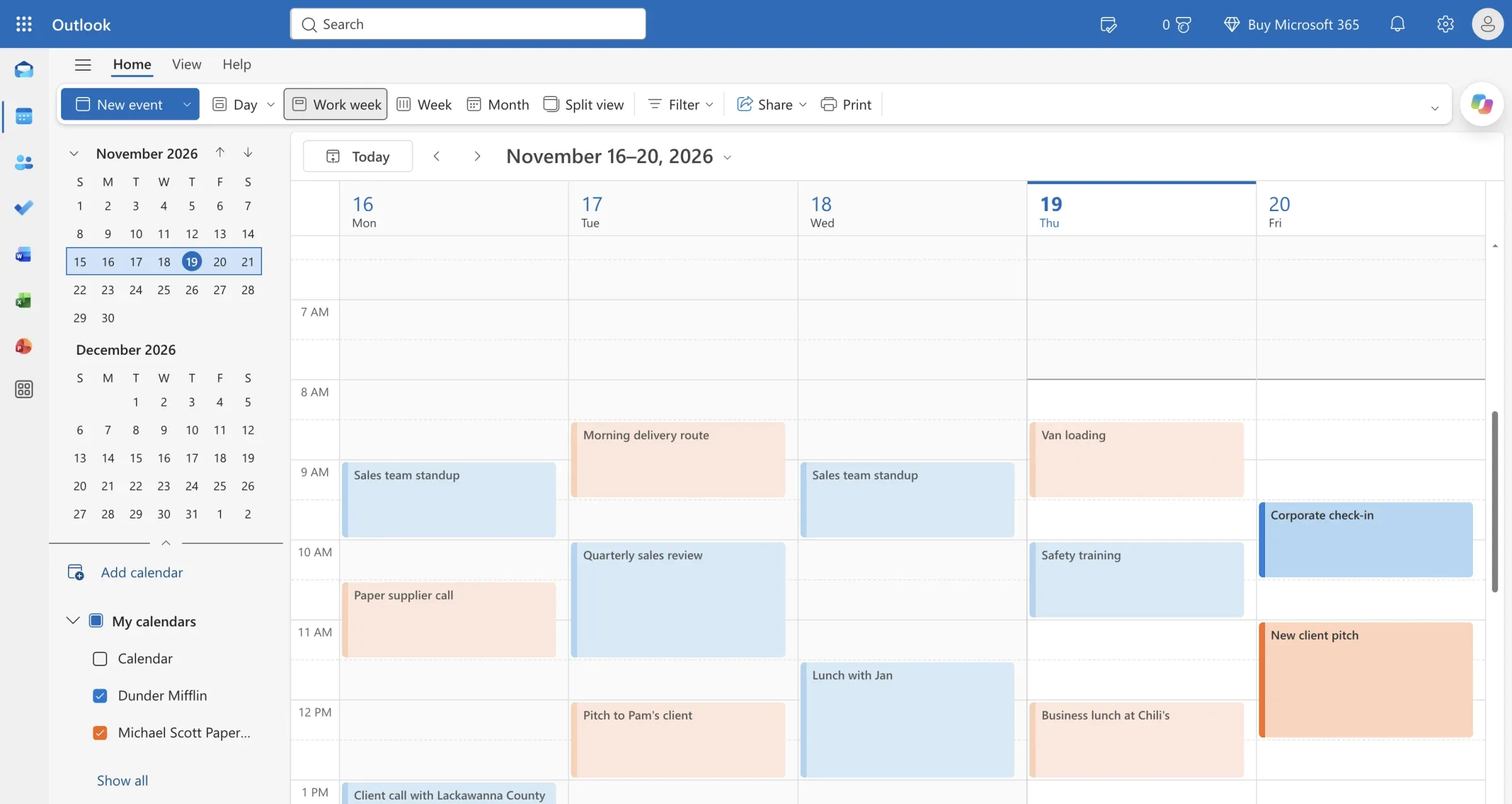
If the calendars show next to each other, Split view is on, so turn it off to merge them into one view.
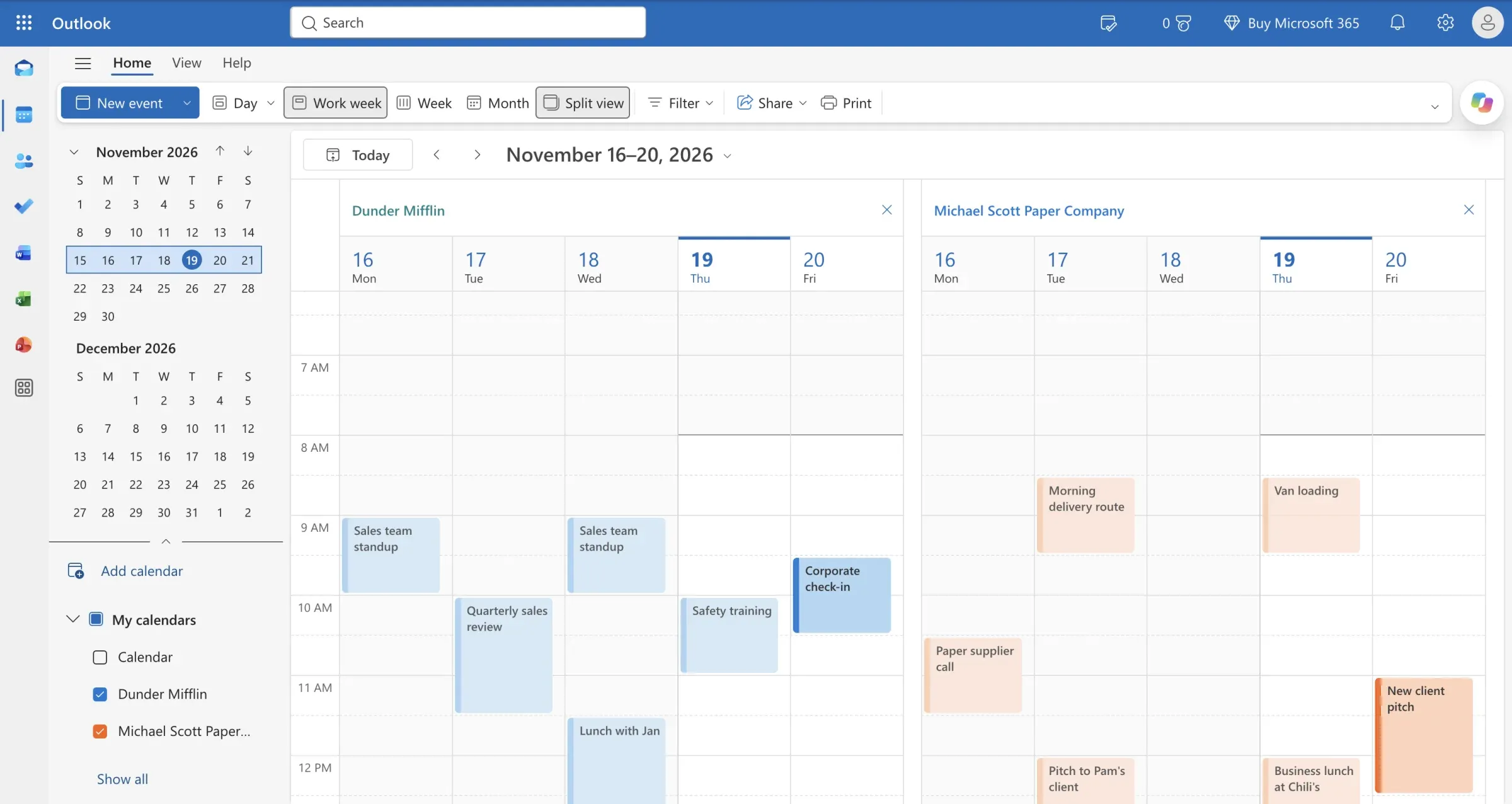
In Outlook for iOS and Android, select the calendars in the calendar list to show them together.
Merge a shared calendar with your own
A calendar that a coworker shared with you works the same way as your regular calendars. First, accept the sharing invitation, or in Outlook on the web, select Add calendar, then Add from directory, and search for the person. The shared calendar appears in your calendar list, and you can overlay it with your own calendar as described above. To share your own calendar, see the steps highlighted in the How to Share Outlook Calendar article we wrote.
Limits of merging Outlook calendars using overlay view
- It is only a view on your screen, meant for you to view multiple connected calendars in the same view. This means that coworkers who schedule a meeting with you still see only your main calendar.
- A new event is saved in the calendar that is in front, so make sure you check which calendar is active before you create the event.
- Overlay view only shows calendars in the Outlook account you are signed in to. To use the overlay view, you have to connect the other calendars to the Outlook account you're using.
If your calendars are spread over several accounts and providers, you can use the OneCal Unified Calendar View to manage every Outlook, Google, iCloud and CalDAV calendar in one view on the web, iOS and Android.
How to Merge Outlook Calendars from Different Accounts by Sharing and Importing
When the two calendars are in different Outlook accounts, you first have to bring one into the other. You do this by publishing the first Outlook Calendar and subscribing to it from the second Outlook account. For this example, let’s call the Outlook Calendar we’ll publish Calendar A, and the Outlook Calendar we’ll add it to Calendar B.
To add Calendar A to the account of Calendar B, let’s follow these steps in Outlook on the web:
- Sign in to Outlook on the web with the account that owns Calendar A.
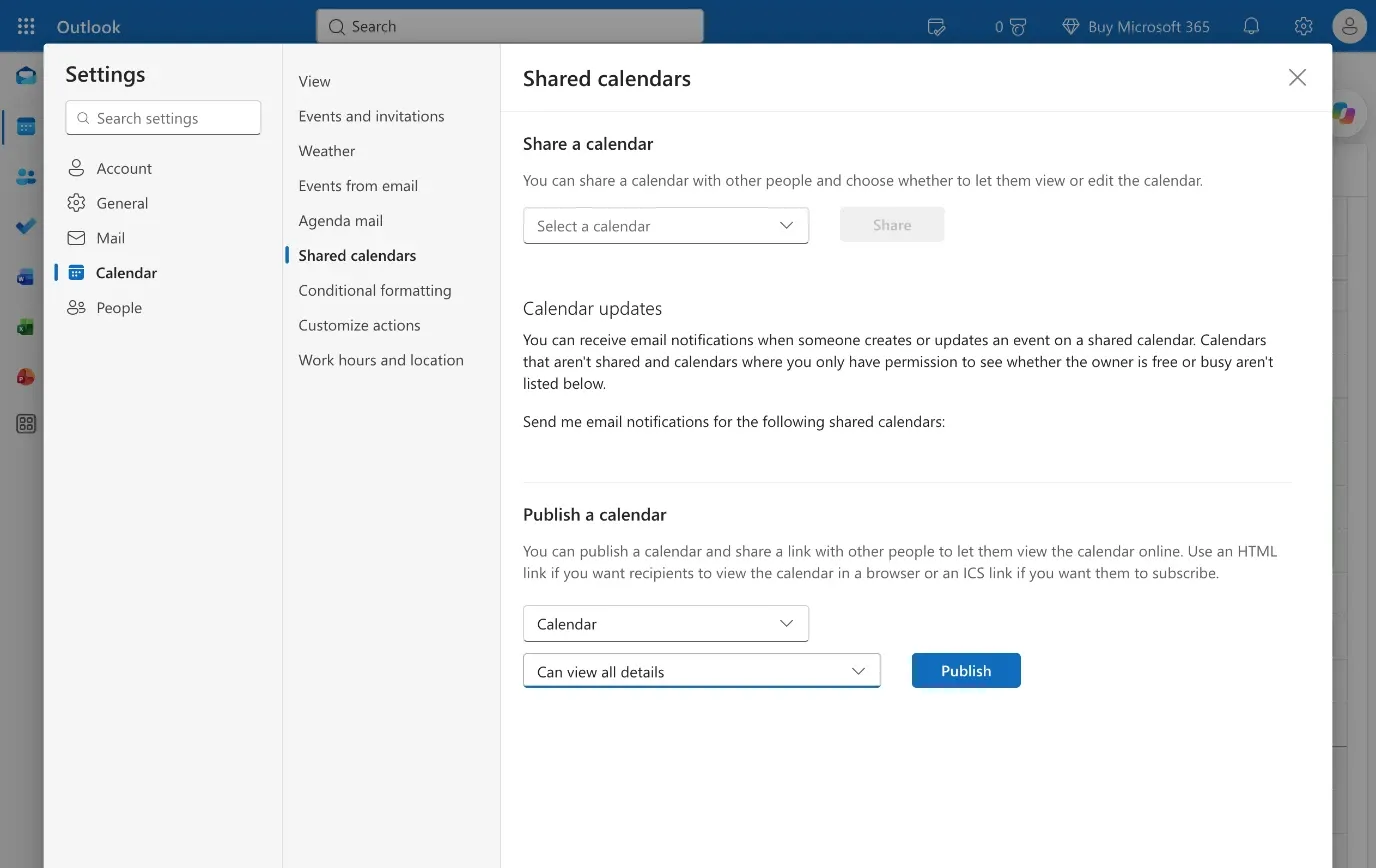
- Select Settings (the gear icon), then Calendar, and then Shared calendars.
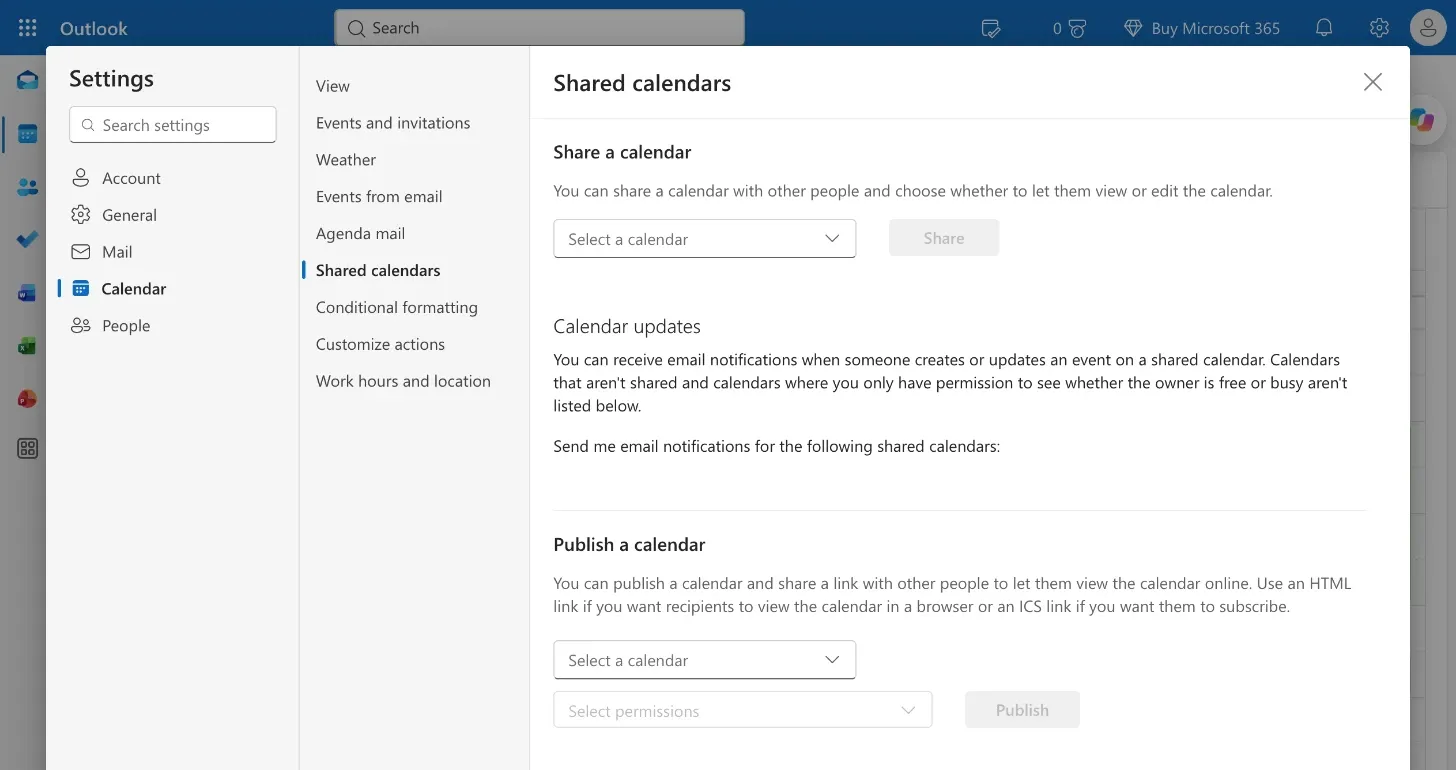
- Under "Publish a calendar", choose Calendar A and the level of detail between "Can view all details" if you want to see the full events in the other account, or "Can view when I'm busy" if busy blocks are enough. If "Can view when I'm busy" is the only option, your Microsoft 365 admin has limited what you can publish.
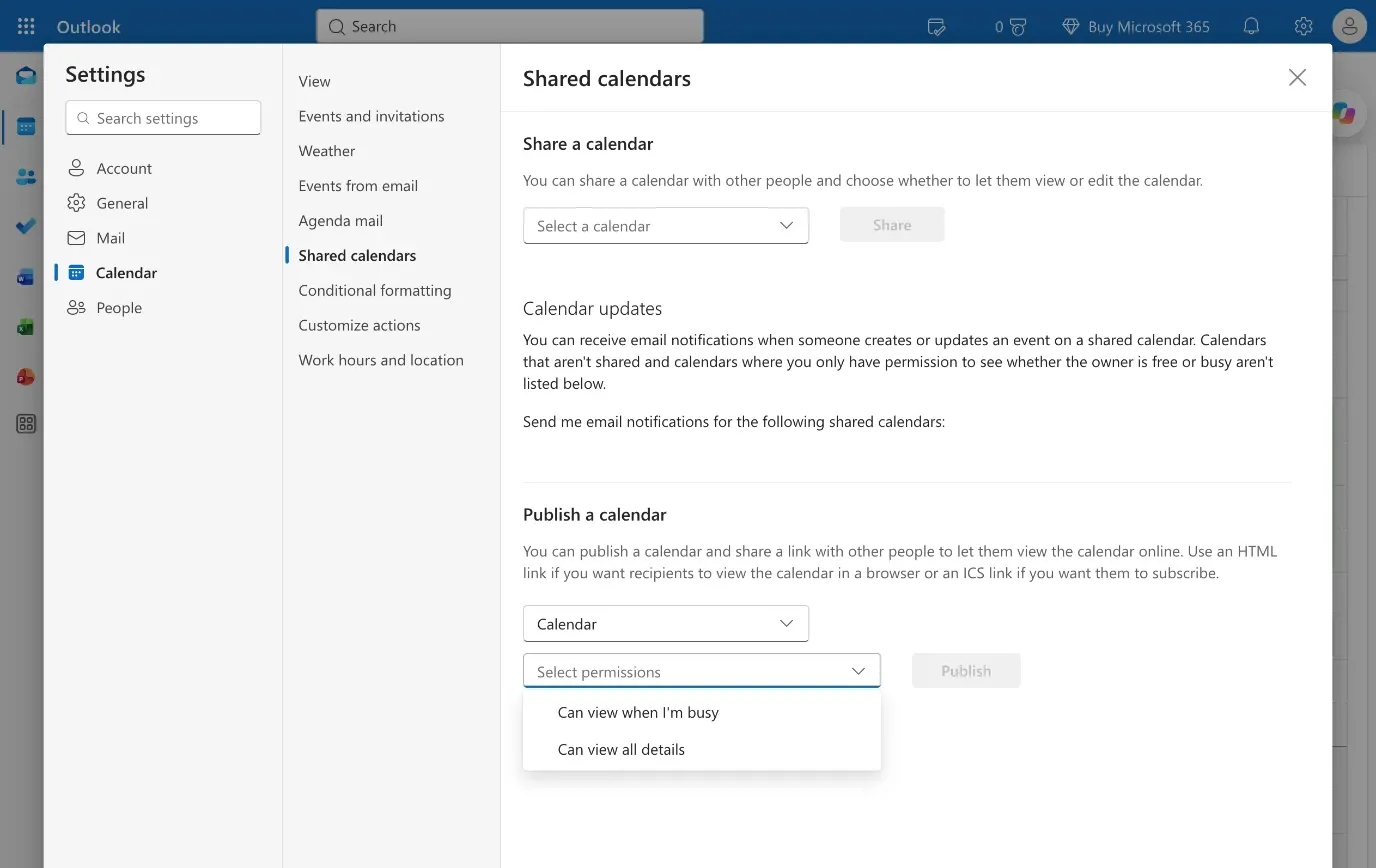
- Select Publish.
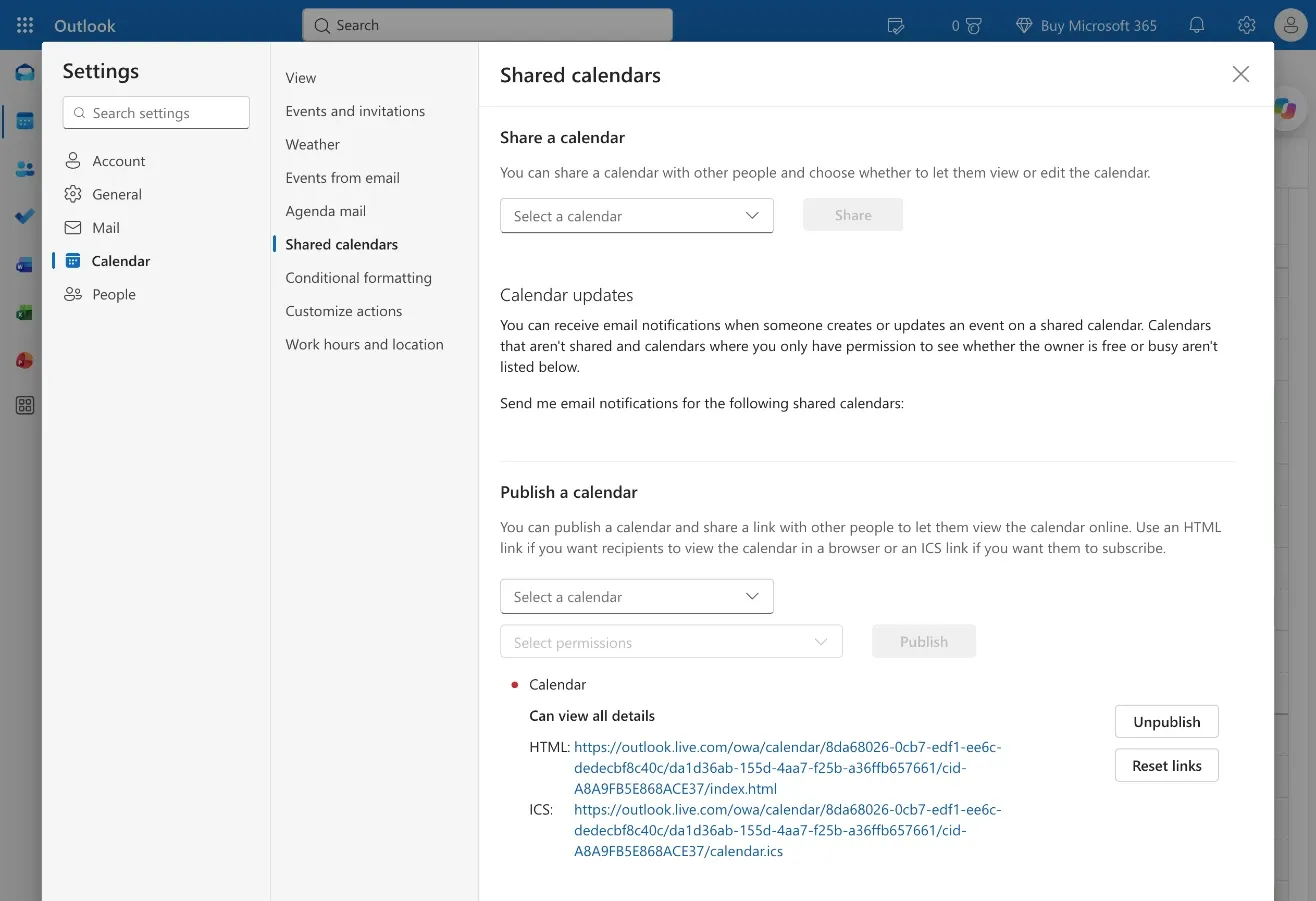
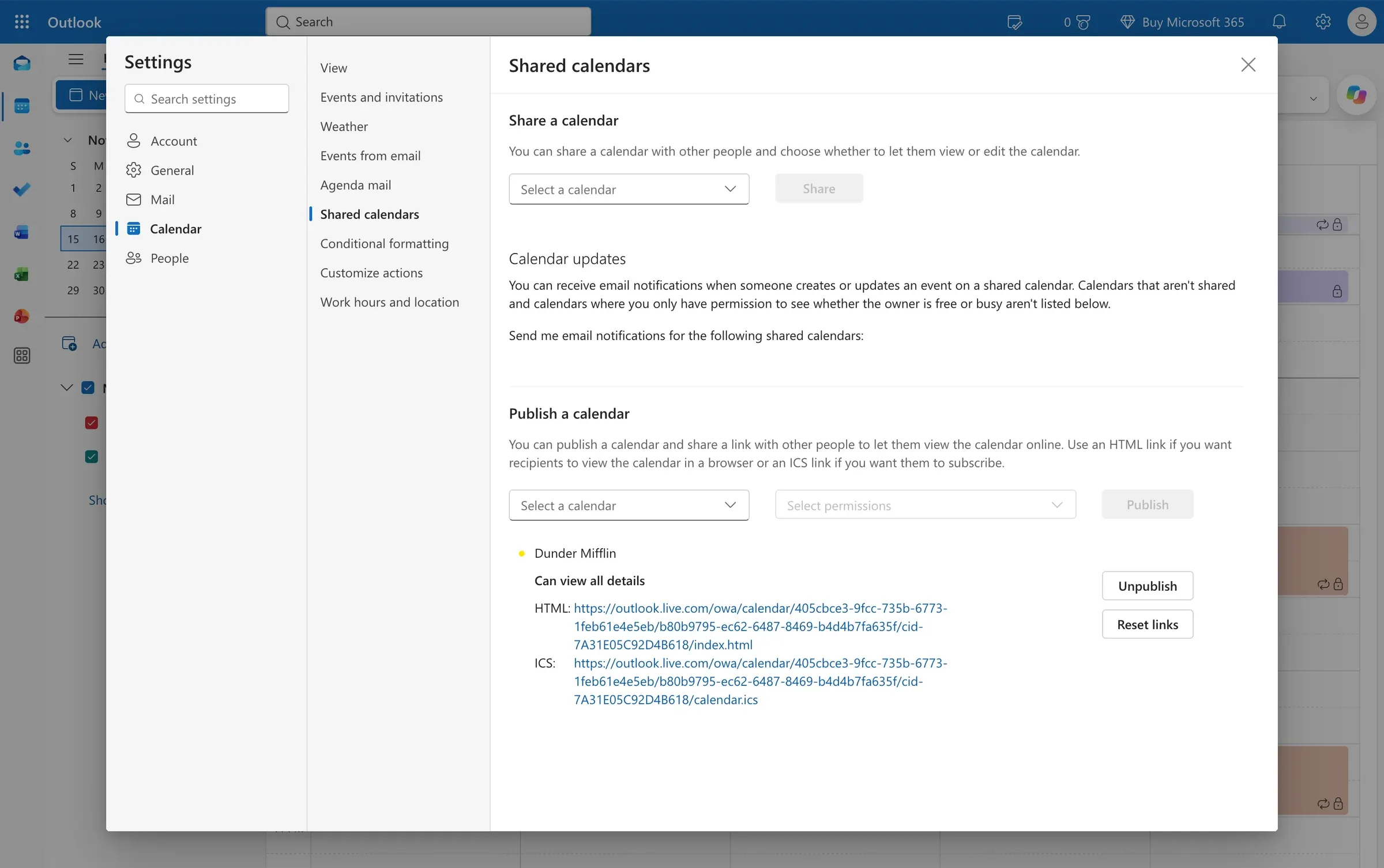
- Copy the ICS link (below the HTML link).
- Sign in to Outlook on the web with the account that owns Calendar B.
- In Calendar, select Add calendar.
- Select Subscribe from web and paste the ICS link you copied from Calendar A.
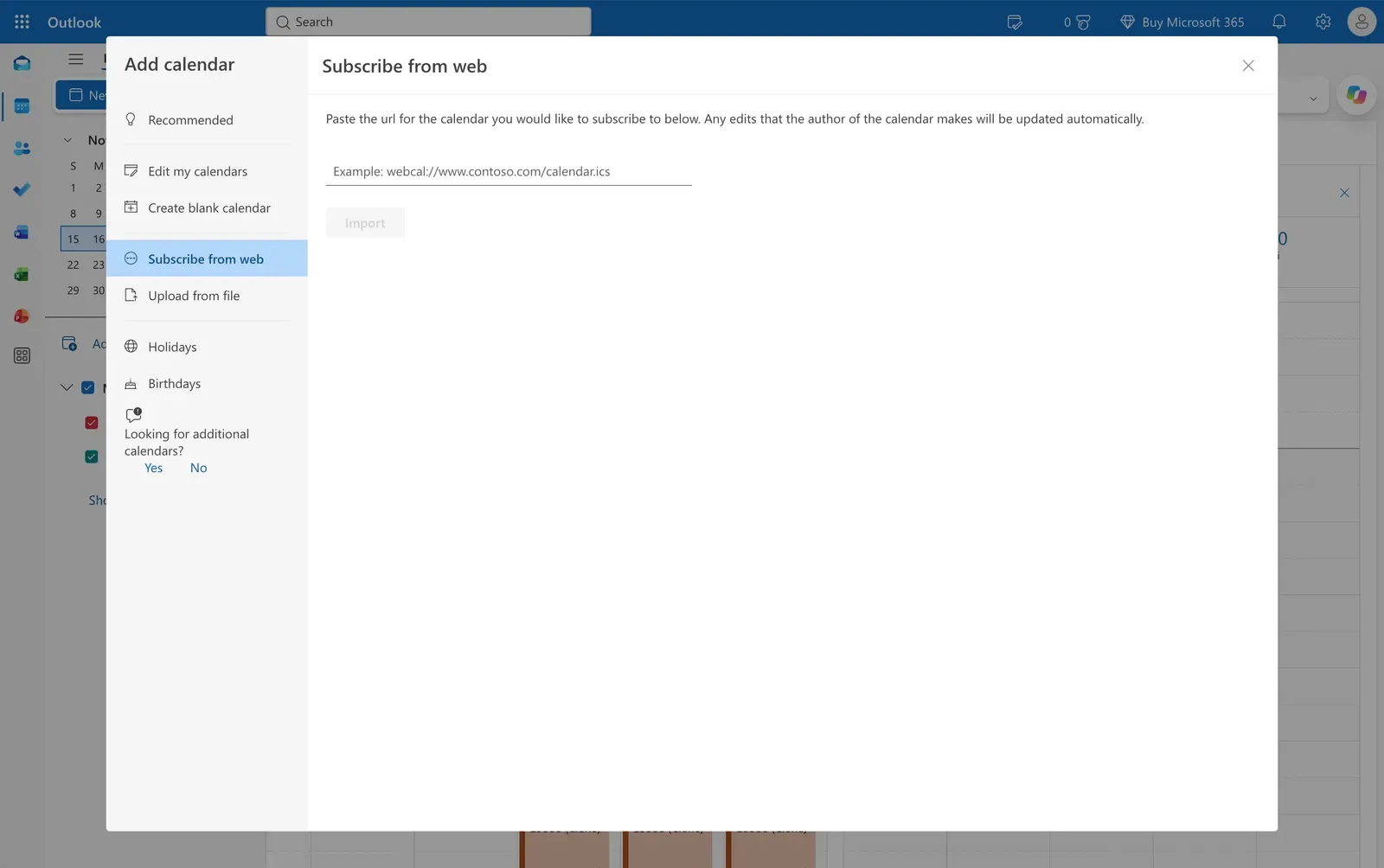
- Select Import.
Calendar A now appears in Calendar B's calendar list, and you can overlay the two. If you also want to see Calendar B in Calendar A's account, repeat the same steps in the other direction. Our guide on how to subscribe to an ICS calendar in Outlook covers the subscription steps in more detail.
Pro Tip: The most reliable way to keep multiple Outlook Calendars merged is by using OneCal. You don’t have to repeat the same steps for each direction, because one multi-way calendar sync can keep up to 8 calendars mirrored.
Cons of Merging Outlook Calendars by Sharing and Importing
- It is not a real merge: Publishing creates a subscribed, read-only calendar in the other account. Events from Calendar A are never added to Calendar B and only appear alongside it.
- Limited privacy controls: You can hide details by publishing with "Can view when I'm busy", but the level applies to the whole calendar. You cannot show some events and hide others, and anyone who gets the link can open it. If you publish with all details, workspace administrators of the other account might have access to those details.
- Slow Calendar Merges: Microsoft says a subscribed calendar should update about every 3 hours on Outlook.com and about every 6 hours in Outlook on the web for work accounts, and that an update can take more than 24 hours.
- Members can’t see that you are busy. For example, when you add Outlook Calendar A to Outlook Calendar B, team members of Calendar B won’t be able to see that you are busy during the time slots in Calendar A, even though you see both Calendars in one view. This happens because when they use the Scheduling Assistant in Outlook, Outlook only checks for busy slots on the primary calendar, not on the subscribed calendar.
- Time-consuming to set up. You have to follow 9 steps for each direction and for each pair of calendars, and troubleshoot any possible issues. Your Microsoft 365 admin can also turn off publishing.
Way 2: Merge Outlook Calendar by exporting/importing
There are cases where you manage two Outlook calendars and want to keep only one, tidy up a second calendar you no longer need, or copy events from one calendar to another. The events are copied once, and after that, the two calendars have nothing to do with each other. All these cases can be done by the Export/Import functionality in Outlook, including New Outlook and Classic Outlook.
Before you start, keep the source calendar until you have verified the result, because there is no undo button for a calendar import.
Export and import in classic Outlook
In Classic Outlook, you can save a calendar as an Outlook Data File (.pst) and import it into another calendar.
- In classic Outlook, select File, then Open & Export, then Import/Export.
- Choose Export to a file, then Outlook Data File (.pst).
- Select the calendar you want to export and select Next. Select Browse to choose where to save the file, then select Finish. Only one account can be exported at a time.
- Open the account that holds the calendar you want to keep, then select File > Open & Export > Import/Export again.
- Choose Import from another program or file, then Outlook Data File (.pst), and pick the file.
- Choose the option "Do not import duplicates", select the calendar you want to import into, and finish.
Export and Import Outlook Calendars in New Outlook and Outlook on the web
New Outlook and Outlook on the web do not have the .pst wizard, but they do have an export and import feature via an .ics file:
- The first step is to get an .ics file of the source calendar. If you published the calendar as described above, open the ICS link in a browser to download the file.
- In the account you want to keep, open Calendar and select Add calendar.
- Select Upload from file, select Browse, and pick the .ics file.
- Choose the calendar to import into and select Add to calendar.
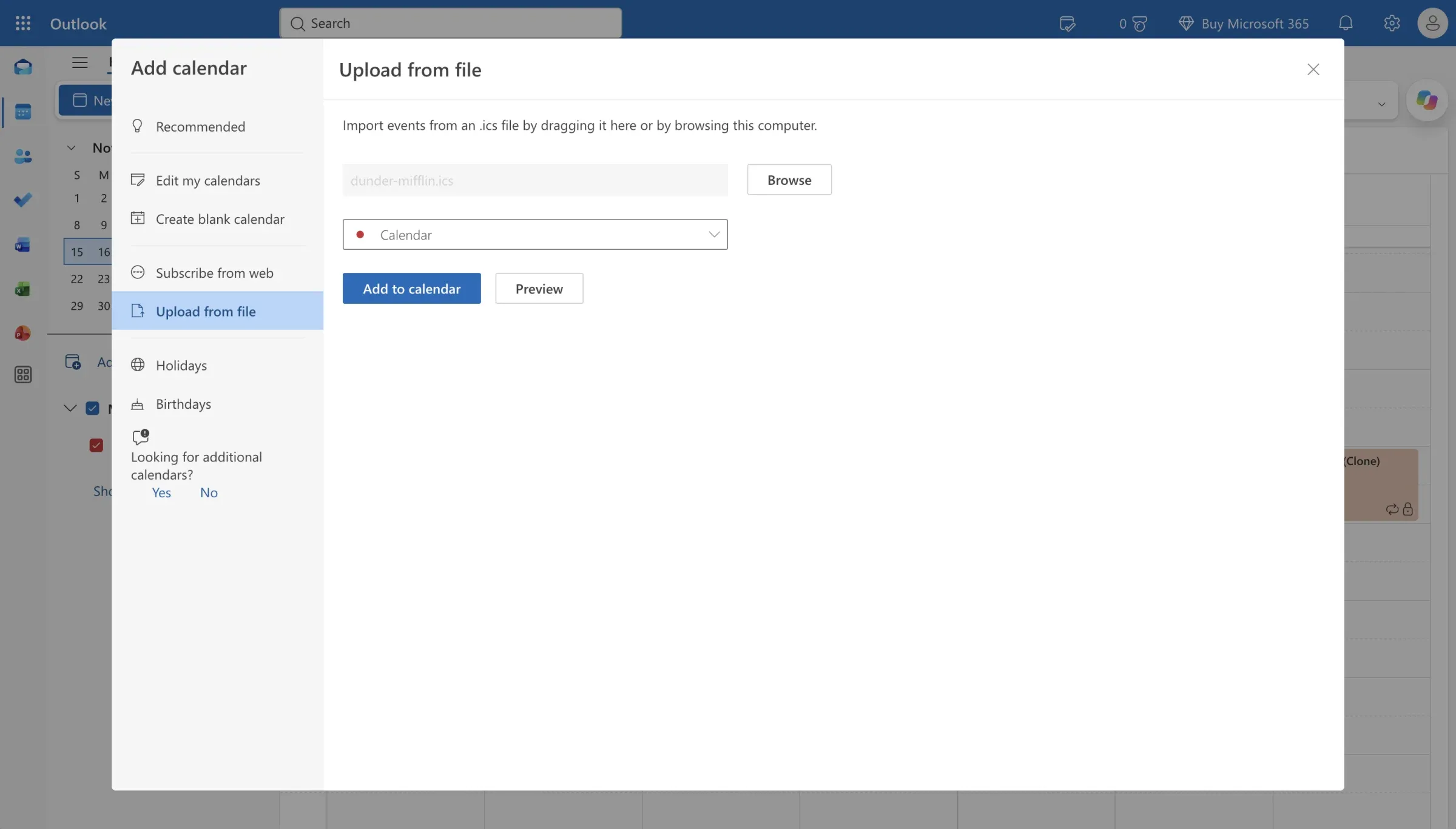
The imported .ics file is a snapshot, meaning the events are added once and don't update later.
How to merge Outlook calendars without getting duplicate events
In order for your Outlook calendars to stay tidy and free of duplicate events, please follow the advice below:
- Import each file only once, because every new import of the same .ics file can add the same events again.
- In classic Outlook, choose "Do not import duplicates" in the import wizard.
- If you are not sure about the result, export the calendar and import it into a new, empty calendar first. If something looks wrong, you can delete that calendar and start again, while your main calendar stays clean. You can create as many Outlook calendars as you want in the New Outlook or Classic Outlook.
Keep in mind that copied events are independent; there is no tie between the original events that you exported and the events that appear after you import. A meeting someone else organized becomes a plain copy in the new calendar, so later changes from the organizer don't reach it.
Way 3: Keep Outlook calendars merged automatically with a calendar synchronization tool
Overlay view doesn't show your busy time to coworkers, and an import can be out of date the next day. If you keep using both calendars, they need to mirror each other at all times, which is what a calendar sync does.
One of the best third-party tools for merging Outlook Calendars this way is OneCal.
OneCal is a calendar sync tool that creates real events on each Outlook Calendar and keeps them updated in real time. The best part is that the merge setups are customizable, so you can choose which event properties to merge. To learn more about the calendar synchronization features, visit our Outlook calendar sync page.
OneCal is not a one-time migration tool, so if you only want to move old events into one calendar and stop using the other, use Way 2.
How to Automatically Merge Outlook Calendars using OneCal
1. Start a 14-day free trial and connect your Outlook Calendars
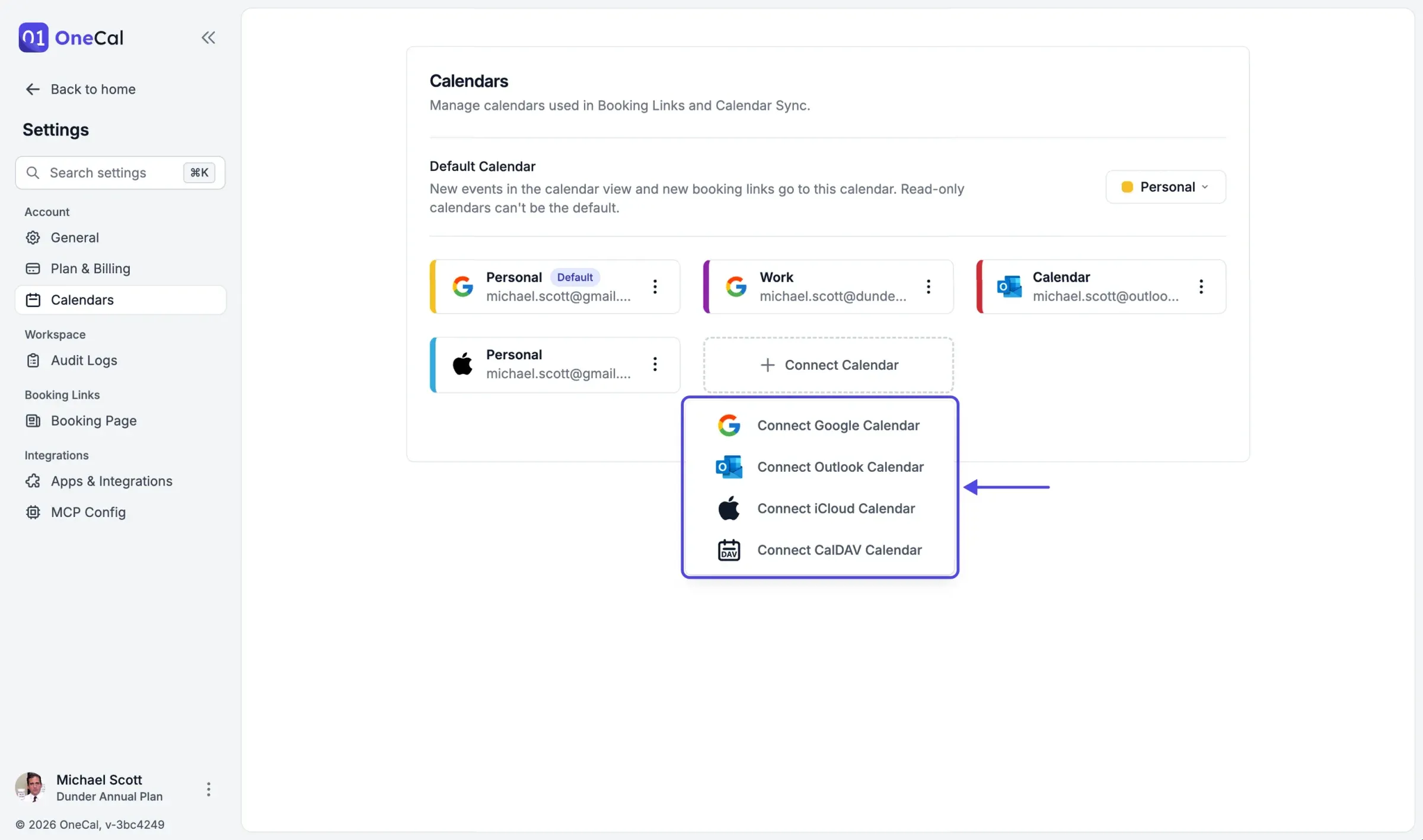
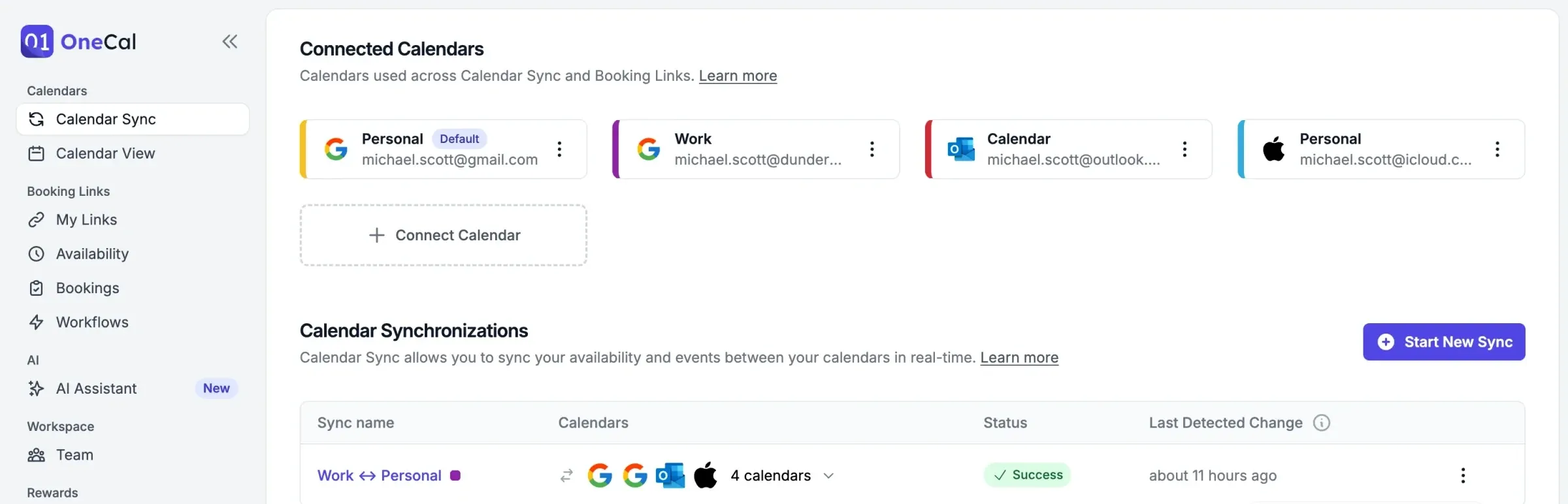
If you don't have a OneCal account, you can start a 14-day free trial, no credit card is required. Then click "Connect Calendar", choose "Connect Outlook Calendar", sign in to each Outlook account, and choose which of its calendars to add. OneCal works with personal Outlook.com accounts and Microsoft 365 work accounts, although a work account may need approval from your admin. The number of calendars you can connect depends on the plan: 2 on Starter, 5 on Essential, and 50 on Premium.
2. Click "Start New Sync" and choose the direction
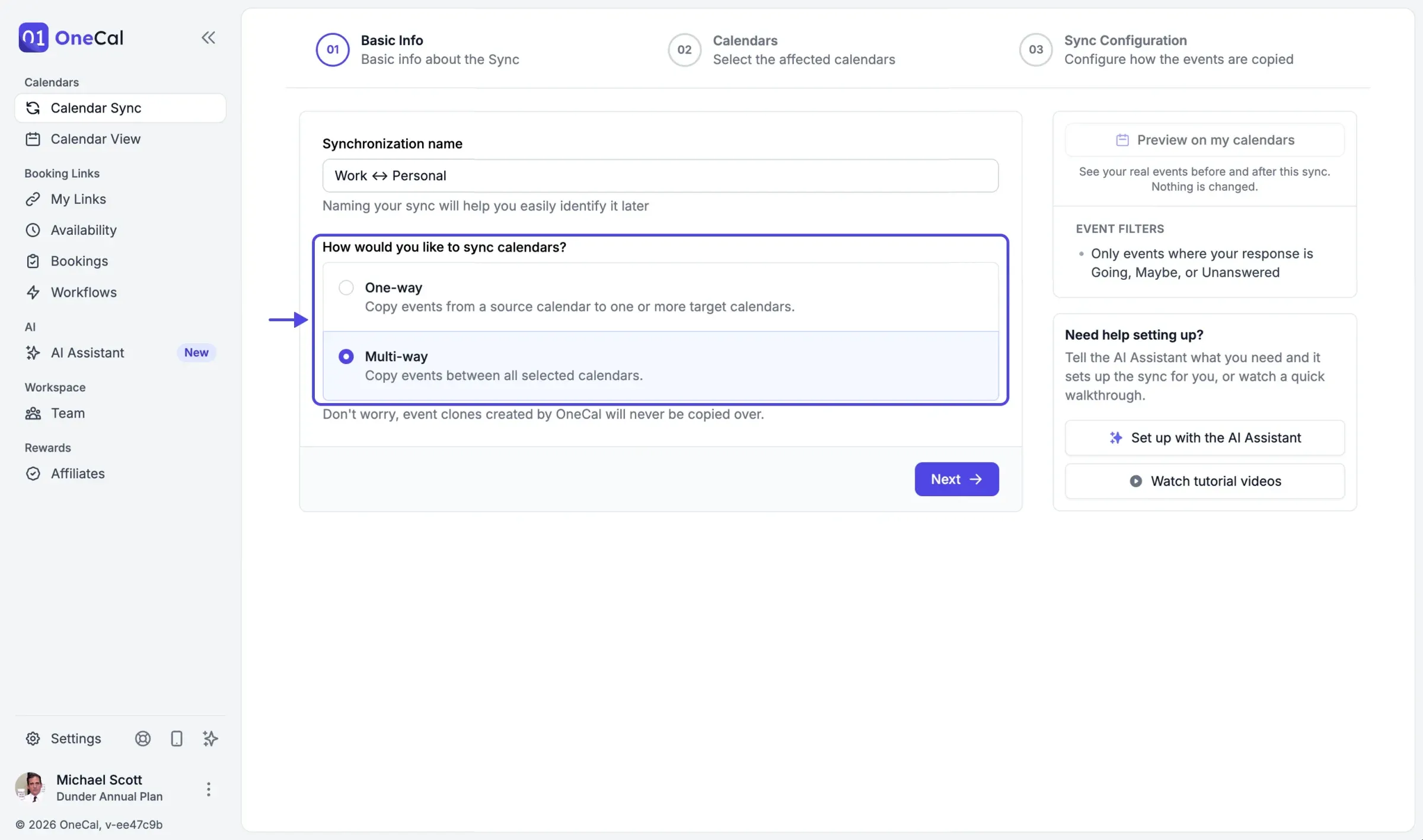
Click "Start New Sync" on the Calendar Sync page. Choose "One-way" if events should go from one calendar to another only, or choose "Multi-way" if the calendars should mirror each other, which is what most people mean by a merge.
3. Choose which Outlook Calendars to merge
With OneCal, you can merge one Outlook Calendar with another, or multiple Outlook Calendars at the same time.
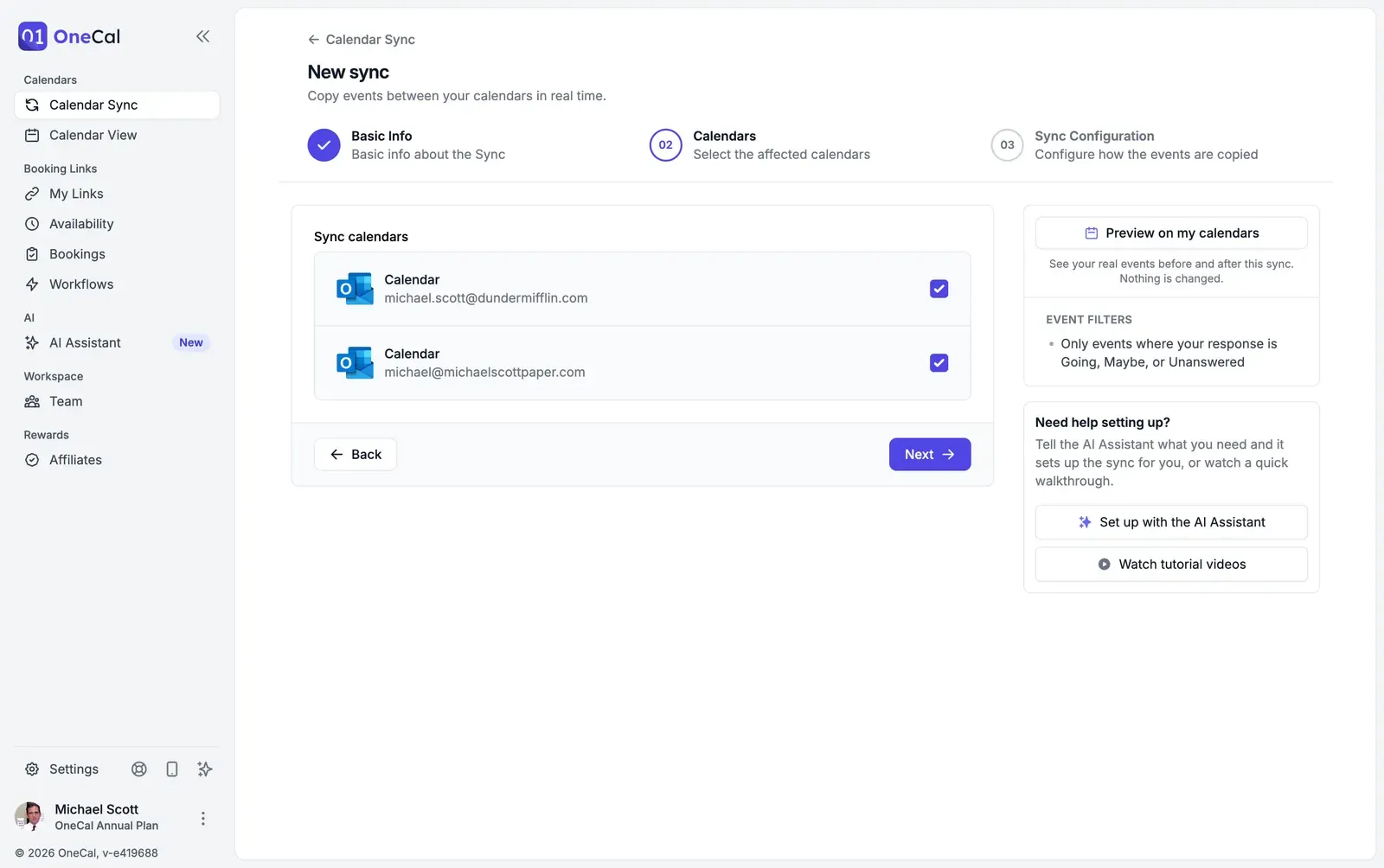
4. Configure how events are merged during the merge process
OneCal allows you to choose which meeting properties you want to merge. For example, you may want to merge a personal and a work Outlook Calendar. You can strip out all private details from your personal Outlook Calendar, so nobody on the Work Calendar can see the private meeting information.
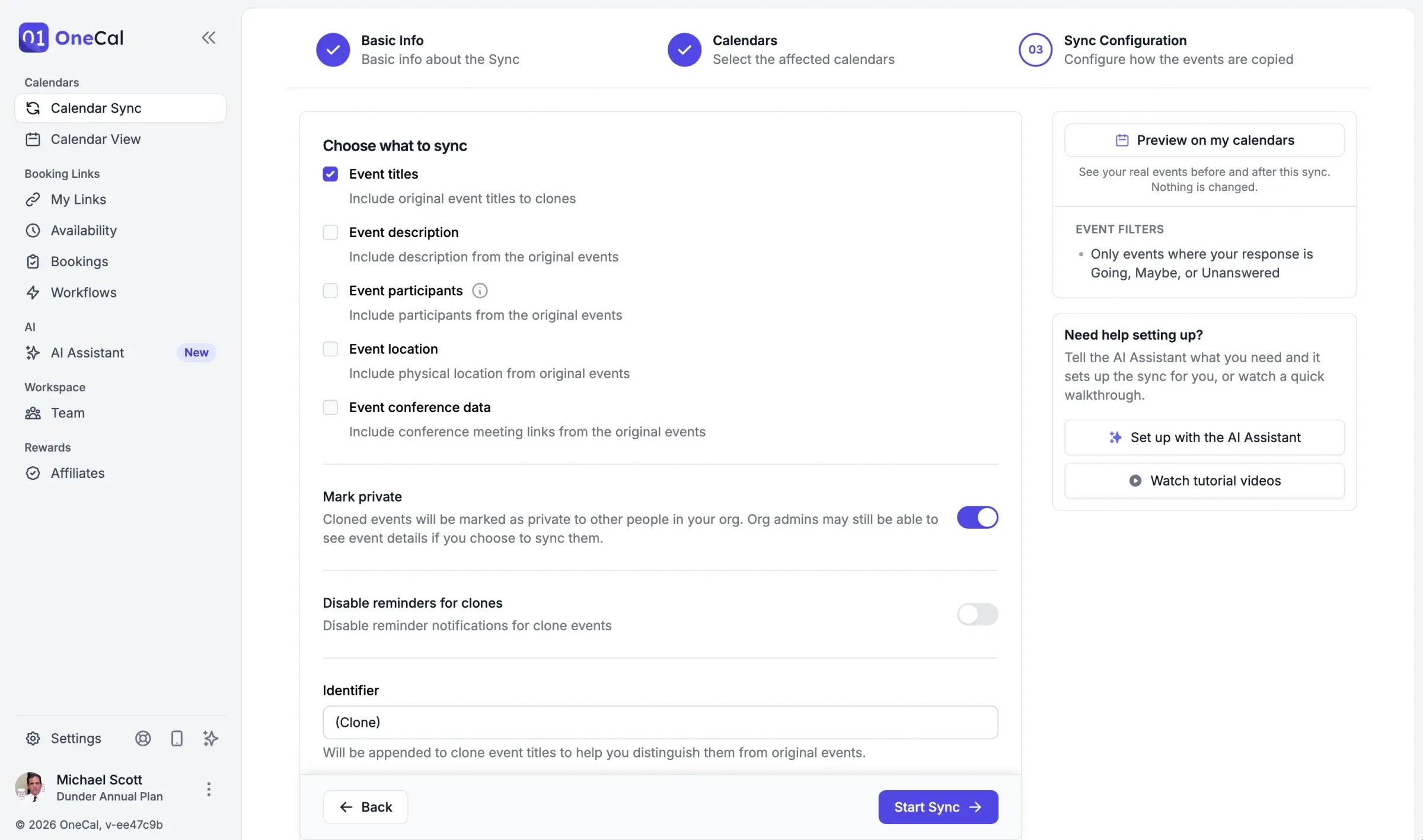
5. Preview and start the calendar sync
Click "Preview on my calendars" to see your real events before and after the calendar sync, without changing anything in your calendars. Then click "Start Sync", and OneCal keeps the calendars merged without any further work.
Your Outlook Calendars are merged!
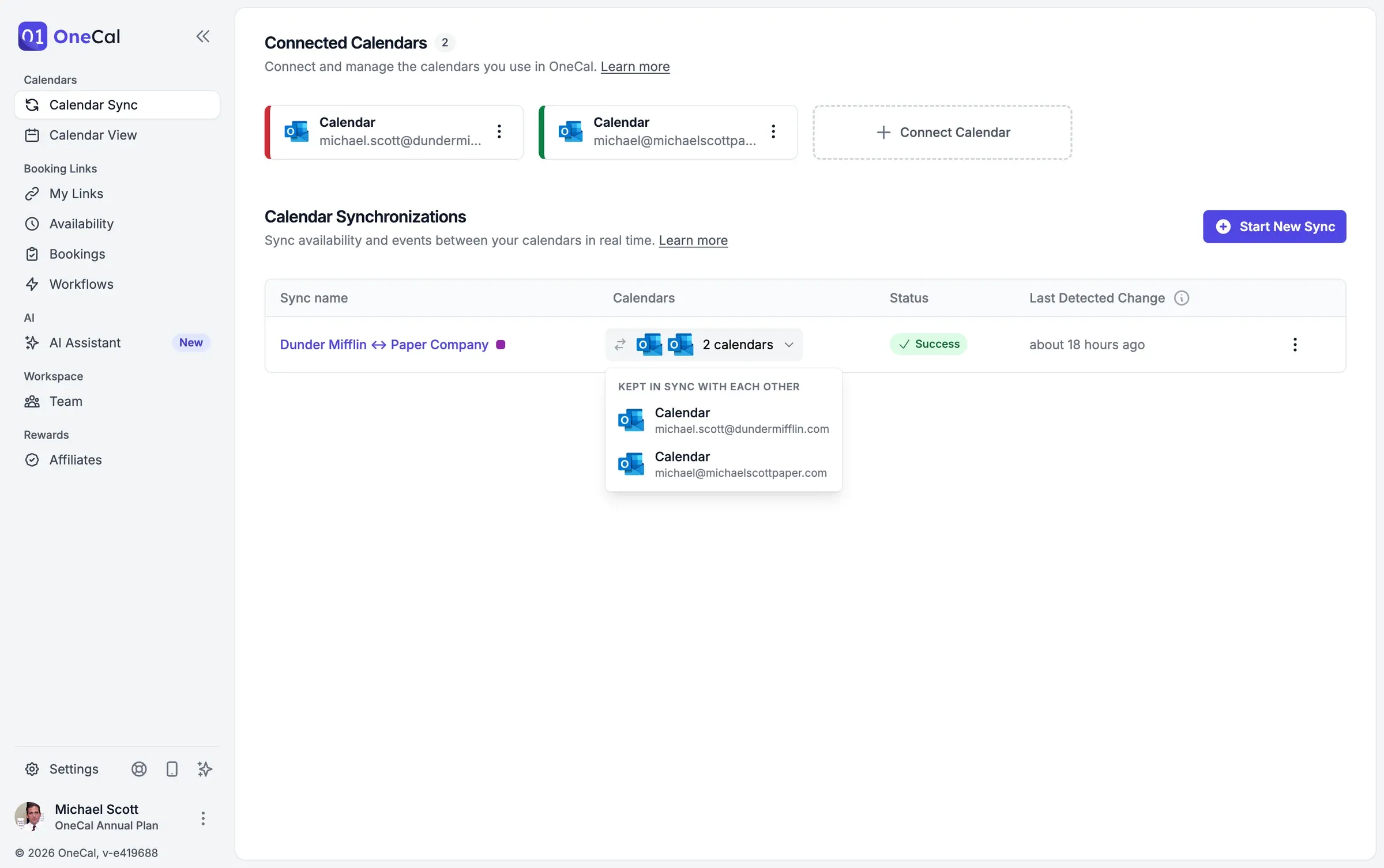
Merged calendars can look crowded because each event now exists on every calendar. The OneCal Unified Calendar View can hide clone events, so you see each meeting once.
What are the Pros of Merging Multiple Outlook Calendars using OneCal?
- Quick to set up. OneCal takes 2 minutes to set up, even less if you ask the AI Assistant to set up the calendar synchronization for you. The only manual thing you need to do is to connect your calendars to OneCal, AI Assistant can take care of the rest.
- Merge Outlook Calendars with Privacy in mind. It’s very important to keep private information from being exposed when merging Outlook Calendars; that’s what makes the Outlook Calendar merge process OneCal offers so crucial, as you are in control of what to merge.
- Real-time Calendar Updates: When merging two or more Outlook Calendars through Sharing and Importing, you have to follow many steps, and in the end, the merge is not real-time. With OneCal, you can be sure your Outlook Calendars will stay merged in real time, automatically.
Use OneCal to Merge Outlook Calendars
Overlay view is enough when you only want to see your calendars together, and export and import is the way to move events for good. When you need Outlook Calendars that stay merged, OneCal is the easiest and most reliable option. The whole setup takes two minutes and after you're done you'll have peace of mind that your Outlook Calendars will stay merged while you focus on growing your business or what’s important to you.
OneCal has three plans, all priced per user. Starter costs $6 per month ($5 billed annually) and connects 2 calendars, Essential costs $12 per month ($10 billed annually) and connects 5 calendars, and Premium costs $30 per month ($25 billed annually) and connects 50 calendars. Every plan includes unlimited calendar syncs.
You can sign up for a 14-day free trial, no credit card required, to experience a time-saving tool that merges your Outlook Calendars, allows you to share booking links, view multiple calendars simultaneously, and much more.
Related guides:
- How to Sync Multiple Outlook Calendars Together, if your goal is to sync and not to merge
- How to Sync Outlook and Google Calendars
- The Best Outlook Calendar Apps and Tools
- How to Fix an Outlook Calendar That's Not Syncing
FAQ
Can you merge two calendars in Outlook?
Yes, in three ways, although Outlook has no single merge button. Overlay view shows two or more calendars as one, export and import copies the events of one calendar into another, and a calendar sync keeps two calendars mirrored.
How do I combine two Outlook calendars into one?
In classic Outlook, export one calendar as an Outlook Data File (.pst) using File > Open & Export > Import/Export, then import it into the other calendar with the option "Do not import duplicates". In new Outlook and Outlook on the web, use Add calendar, then Upload from file, with an .ics file. Both are one-time copies.
How do I overlay calendars in new Outlook?
Select the calendars in your calendar list, then clear Split view on the Home tab. Events from all selected calendars appear on one calendar in their own colors.
What is the difference between overlay view and merging?
Overlay view only changes what you see, while the events stay in their own calendars. Merging by export and import copies the events into one calendar, so they exist there even if you delete the other calendar.
How do I merge a shared calendar with my own?
Add the shared calendar to your calendar list and overlay it with your own calendar. If its events must also block time on your own calendar, you have to copy them there with an import or a calendar sync.
How do I merge calendars without duplicates?
Import each file only once, choose "Do not import duplicates" in classic Outlook, and test the import in a new, empty calendar first. Pause any tool that copies events between the calendars while you import.
Can I undo a calendar merge?
You can turn off overlay view at any time. An import cannot be undone with one click, so keep the source calendar until you have checked the result, or import into a new calendar that you can delete.
Can I merge an Outlook calendar with a Google or Apple calendar?
Overlay view only works for calendars inside Outlook, but you can subscribe to a Google or iCloud calendar by link to see it in Outlook. To keep the calendars mirrored, use a calendar sync, as explained in How to Sync Outlook and Google Calendars.
What is the main downside of merging Outlook calendars by sharing/importing?
Event updates, deletions, or creations can take many hours to appear, the level of detail you publish applies to the whole calendar, and it doesn’t block time when you subscribe to the calendar (creates a secondary calendar).
Why do busy times stay invisible to coworkers after importing a calendar?
Outlook’s Scheduling Assistant only checks the primary calendar; subscribed calendars are secondary, so it ignores them, and your busy blocks remain unseen.
How can I automatically merge multiple Outlook calendars?
You can do this with OneCal. Connect the calendars in OneCal, click "Start New Sync", pick the direction and the calendars, and save, and OneCal then copies events in real time without manual exports.
Using OneCal, can I control which event details get merged between calendars?
Yes. In OneCal, you can choose which fields are copied, such as the title, description, location, participants, and meeting link. You can also hide everything behind a custom title such as “Busy”, so the target calendar shows only generic blocks.
Does OneCal keep merged calendars updated in real time?
Yes. Outlook calendars update in real time, which removes the long delay of the native method.